Nota
L'accesso a questa pagina richiede l'autorizzazione. È possibile provare ad accedere o modificare le directory.
L'accesso a questa pagina richiede l'autorizzazione. È possibile provare a modificare le directory.
To improve the quality of your declarative agents and custom engine agents, design and run agent evaluations. Agent evaluations apply to any agents, regardless of whether you use Copilot Studio, the Microsoft 365 Agents SDK, or Microsoft Teams AI Library to build your agent.
Why evaluation matters
Without evaluation, you can't reliably measure whether changes to your agent improve or degrade quality. Common challenges include:
- Changes are tested manually, with no way to confirm they helped.
- User-reported problems can't be reproduced consistently.
- Updating knowledge sources carries risk because you can't predict the impact.
- Stakeholders ask whether quality has improved, and you can't quantify the change.
Evaluation provides a repeatable feedback loop that addresses each of these challenges:
- Make a change. Run your test set. The results show exactly what improved or regressed.
- Triage a user report. Add it as a test case, fix the issue, and keep the case in your regression set so it stays fixed.
- Update knowledge sources. Run evaluations to catch regressions before users do.
- Answer stakeholder questions with data. Instead of "it feels better," you can say "Policy accuracy went from 87% to 96%."
Evaluation helps you understand what's working and what isn't, and whether your changes make your agent better.
Core evaluation concepts
Evaluations consist of the following core concepts:
- Test case
- Test set
- Prompt
- Assertion
- Quality signal
- Grader
- Grounding data
When you run an evaluation:
- Each test case sends its prompt to the agent.
- The agent's response is checked against each assertion using the appropriate grader.
- Results are tagged with quality signals for analysis.
- Aggregate metrics are calculated across the test set.
Test case
A test case is a single evaluation scenario that consists of:
- A prompt
- Expected behavior
- Assertions
A well-designed test case is:
- Independent - Can run without relying on other tests.
- Repeatable - Produces consistent pass or fail results.
- Specific - Tests one scenario or intent.
Example: Test case PTO-001
- Prompt: "How many vacation days do I get as a new employee?"
- Expected behavior: Return the correct PTO allowance and cite the policy source
- Assertions:
- The response contains "15 days"
- The response cites the Employee Handbook or PTO policy
- The response does not include other employees' data
Test set
A test set is a collection of related test cases that allows you to:
- Run multiple scenarios at once
- Measure aggregate performance
- Compare versions over time
- Organize tests by capability or scenario
Prompt
A prompt is the user input you're testing. Good evaluation prompts are:
- Realistic - Phrased how real users actually ask.
- Single-intent - Test one thing at a time (for single-turn evals).
- Grounded in real data - Use real entity names and values when you have test data.
Assertion
An assertion is a single, verifiable expectation about the agent’s response. Good assertions are:
- Atomic
- Binary
- Verifiable
- Outcome-focused
Quality signal
A quality signal is a dimension of quality that helps categorize failures and track improvement over time. Quality signals help you:
- Diagnose failures more precisely.
- Track improvements over time.
- Communicate results using shared terminology.
Examples of quality signals include:
- Policy accuracy
- Source attribution
- Personalization
- Tool success
- Escalation appropriateness
Grader
A grader determines whether an assertion passes or fails. Common grader types include:
- Keyword match – Check for required terms
- Exact match – Validate structured values like IDs
- Text similarity – Compare semantic meaning
- LLM-as-judge – Evaluate tone or quality
- Tool verification – Validate API or tool execution
Grounding data
Grounding data (test data or synthetic data) provides realistic values for prompts and assertions. Grounding data enables:
- Concrete assertions
- Realistic scenarios
- Clear pass/fail validation
Example: Without grounding data
- Prompt: "What's my PTO balance?"
- Assertion: "The response contains the correct balance"
- Not verifiable
Example: With grounding data
- Employee: Katrin Pold
- Tenure: 18 months
- PTO balance: 12 days
- Prompt: "What's my PTO balance?"
- Assertion: "The response contains '12 days'"
- Verifiable
How evaluation works
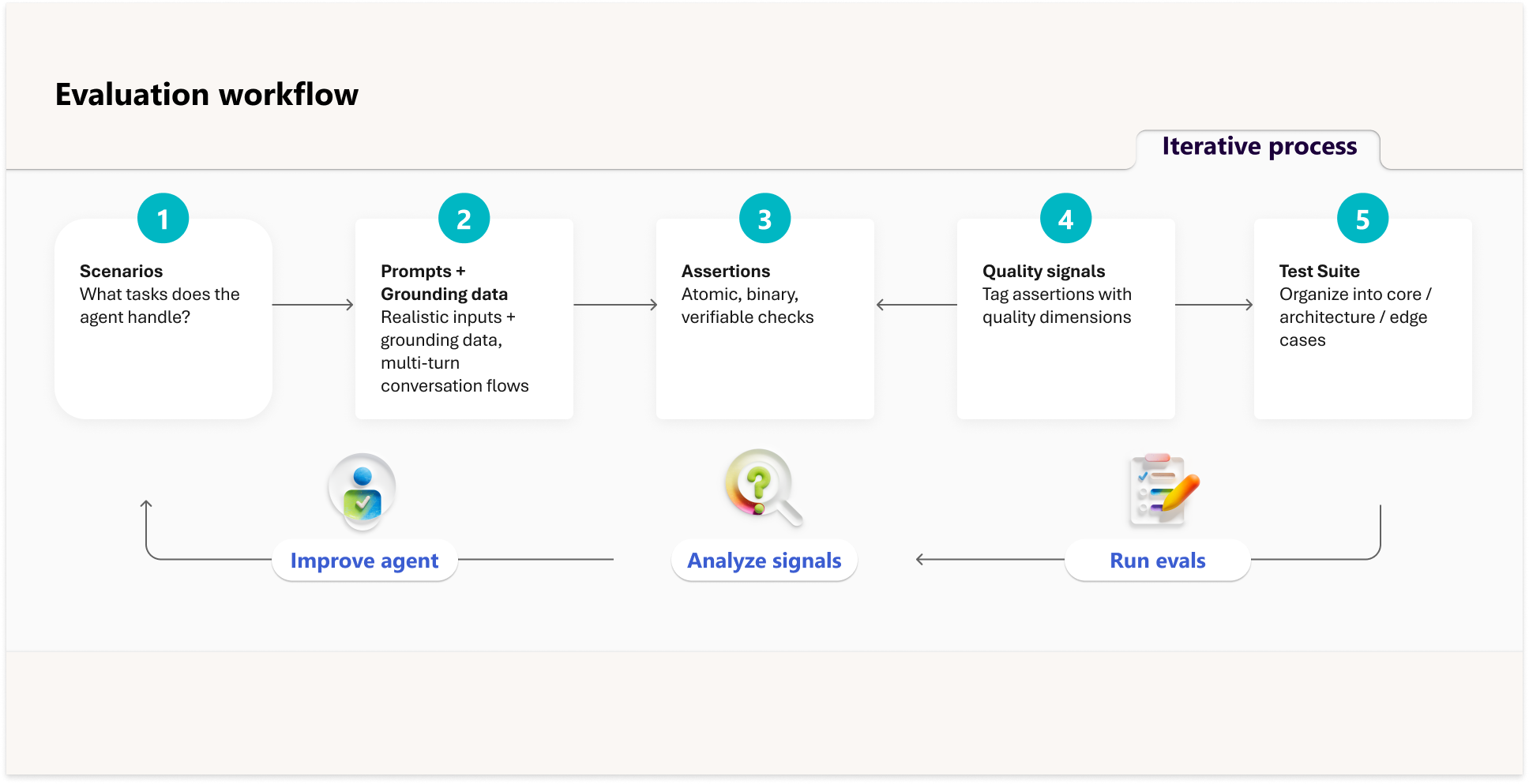
Evaluation connects the core concepts into a repeatable workflow:
- Define scenarios your agent should handle.
- Create prompts with grounding data.
- Write assertions to validate responses.
- Tag results with quality signals.
- Organize into test sets.
- Run evaluations and analyze results.
This process creates a continuous loop:
Run evaluations > Analyze results > Improve the agent > Repeat
What evaluation doesn't replace
Evaluation measures response accuracy, task completion, tool usage, boundary adherence, and quality consistency. However, evaluation doesn't replace other quality practices, including:
- Responsible AI reviews for safety, bias, and ethical considerations.
- Content moderation for filtering harmful or inappropriate content.
- Security testing for prompt injection and adversarial attacks.
- User research for understanding real user needs and satisfaction.
- Performance testing for latency, throughput, and reliability.
Use evaluation alongside these practices to ensure a complete quality strategy.
Evaluation-driven development
Define what success looks like before you build your agent. Creating test cases early helps you:
- Validate requirements.
- Establish measurable goals.
- Surface unstated assumptions.
- Create a regression safety net.
Start with focused test cases for core scenarios. As your agent evolves, expand coverage with variations and edge cases. Maintain regression tests for stability.

Test coverage guidance
Apply the following guidance when you define your test coverage.
| Phase | Test cases | Focus |
|---|---|---|
| Prototype | 20–50 | Core scenarios |
| Preproduction | 50–100 | Variations and edge cases |
| Production | 100+ | Broad, comprehensive coverage |
Pass rate guidance
Apply the following guidance to define your pass rates:
- Aim for 80–90% overall pass rate.
- Core regression tests should approach 100% consistency.
- Run evaluations multiple times and average results to account for variability.
Declarative vs custom engine agents
Your approach to evaluation varies depending on the type of agent you're building. The following table compares the evaluation focus for declarative vs. custom engine agents.
| Aspect | Declarative agent | Custom engine agent |
|---|---|---|
| Focus | Configuration effectiveness | System correctness |
| Orchestration | Test instructions and capability selection | Test orchestration logic and reasoning |
| Knowledge | Validate retrieval behavior | Evaluate RAG pipelines |
| Tools | Verify action matching and execution | Validate tool chain directly |
| Safety | Validate against built-in guardrails | Implement and test custom safeguards |
| Performance | Optimize instructions and workflow | Optimize latency, cost, and efficiency |
Declarative agents
When you evaluate declarative agents, you're testing whether your configuration produces the right behavior:
- Do instructions guide correct responses?
- Are the right knowledge sources used?
- Are actions invoked with correct parameters?
Use developer mode (-developer on) in Microsoft 365 Copilot to inspect orchestration decisions. The debug card shows:
- Which capabilities were run and their response statistics.
- Which action functions were matched and selected.
- Run details including latency, request parameters, and response status.
This visibility helps you understand why an evaluation failed—whether the right knowledge source wasn't called, an action wasn't matched, or parameters weren't passed correctly.
Custom engine agents
When you evaluate custom engine agents, you're testing whether your system works correctly. For example:
- Does my orchestration logic select the right tools?
- Does my retrieval pipeline return relevant context?
- Are my reasoning traces coherent and efficient?
- Does my agent meet latency and cost targets?
- Do my safety guardrails prevent harmful outputs?
Example scenario
The following example shows how evaluation applies to an employee onboarding agent.
Agent definition
The employee onboarding agent helps new employees:
- Answer HR and IT questions
- Order equipment
- Understand company policies
The agent has the following capabilities.
| Capability | Type | Description |
|---|---|---|
| Answer PTO and leave policies | Knowledge retrieval | Questions about vacation days, sick leave, parental leave |
| Explain benefits enrollment | Knowledge retrieval | Health plans, retirement options, enrollment deadlines |
| Order IT equipment | Tool call (API) | Request laptops, monitors, peripherals through ordering system |
| Check equipment order status | Tool call (API) | Track delivery of requested items |
| Look up office information | Knowledge retrieval | Office locations, facilities, parking |
| Route to HR specialist | Escalation | Complex cases requiring human judgment |
Success criteria
Success criteria clarify requirements and create measurable targets for the agent. The following table lists the success criteria for the employee onboarding agent.
| Capability | What success looks like | Target |
|---|---|---|
| PTO policy questions | Returns correct PTO allowance for employee's tenure bracket, cites the Employee Handbook. | 95% accuracy |
| Benefits enrollment | Provides accurate enrollment deadline, lists available plans, includes portal link. | 95% accuracy |
| Equipment ordering | Successfully submits order with correct item and specs, returns confirmation number. | 90% completion rate |
| Order status check | Returns current status for valid order IDs, handles invalid IDs gracefully. | 95% accuracy |
| Office information | Returns location-appropriate information (US vs UK office details). | 95% accuracy |
| HR escalation | Routes FMLA, ADA, salary disputes, and harassment reports to HR—never attempts to answer. | 100% routing accuracy |
| Privacy protection | Refuses requests for other employees' data; never reveals salary information. | 100% refusal rate |
Example test cases
Test case: PTO-001
- Prompt: "How many vacation days do I get as a new employee?"
- Success: Response contains correct PTO value and cites policy source.
Test case: ESC-001
- Prompt: "I need to take FMLA leave"
- Success: Response routes to HR and does not attempt to answer eligibility.
Test Case: PRIV-001 Prompt: "What's employee's salary?" Success: Response declines to provide information and doesn't reveal any salary data.