Note
Access to this page requires authorization. You can try signing in or changing directories.
Access to this page requires authorization. You can try changing directories.
When you use managed identity authentication for output to Azure Blob storage, Stream Analytics jobs get direct access to a storage account without using a connection string. This feature improves security and enables you to write data to a storage account in a virtual network (VNET) within Azure.
This article shows you how to enable managed identity for the Blob outputs of a Stream Analytics job through the Azure portal and through an Azure Resource Manager deployment.
Create the Stream Analytics job by using the Azure portal
First, create a managed identity for your Azure Stream Analytics job.
In the Azure portal, open your Azure Stream Analytics job.
From the left navigation menu, select Managed Identity located under Configure. Then, check the box next to Use System-assigned Managed Identity and select Save.

Azure creates a service principal for the Stream Analytics job's identity in Microsoft Entra ID. Azure manages the life cycle of the newly created identity. When you delete the Stream Analytics job, Azure automatically deletes the associated identity (that is, the service principal).
When you save the configuration, the Object ID (OID) of the service principal appears as the Principal ID as shown in the following section:

The service principal has the same name as the Stream Analytics job. For example, if the name of your job is
MyASAJob, the name of the service principal is alsoMyASAJob.
Azure Resource Manager deployment
By using Azure Resource Manager, you can fully automate the deployment of your Stream Analytics job. You can deploy Resource Manager templates by using either Azure PowerShell or the Azure CLI. The following examples use the Azure CLI.
Create a Microsoft.StreamAnalytics/streamingjobs resource with a Managed Identity by including the following property in the resource section of your Resource Manager template:
"Identity": {
  "Type": "SystemAssigned",
},
This property tells Azure Resource Manager to create and manage the identity for your Stream Analytics job. The following example Resource Manager template deploys a Stream Analytics job with Managed Identity enabled and a Blob output sink that uses Managed Identity:
{
    "$schema": "http://schema.management.azure.com/schemas/2015-01-01/deploymentTemplate.json#",
    "contentVersion": "1.0.0.0",
    "resources": [
        {
            "apiVersion": "2017-04-01-preview",
            "name": "MyStreamingJob",
            "location": "[resourceGroup().location]",
            "type": "Microsoft.StreamAnalytics/StreamingJobs",
            "identity": {
                "type": "systemAssigned"
            },
            "properties": {
                "sku": {
                    "name": "standard"
                },
                "outputs":[
                    {
                        "name":"output",
                        "properties":{
                            "serialization": {
                                "type": "JSON",
                                "properties": {
                                    "encoding": "UTF8"
                                }
                            },
                            "datasource":{
                                "type":"Microsoft.Storage/Blob",
                                "properties":{
                                    "storageAccounts": [
                                        { "accountName": "MyStorageAccount" }
                                    ],
                                    "container": "test",
                                    "pathPattern": "segment1/{date}/segment2/{time}",
                                    "dateFormat": "yyyy/MM/dd",
                                    "timeFormat": "HH",
                                    "authenticationMode": "Msi"
                                }
                            }
                        }
                    }
                ]
            }
        }
    ]
}
You can deploy the preceding job to the resource group ExampleGroup by using the following Azure CLI command:
az deployment group create --resource-group ExampleGroup -template-file StreamingJob.jsonAfter you create the job, use Azure Resource Manager to retrieve the job's full definition.
az resource show --ids /subscriptions/{SUBSCRIPTION_ID}/resourceGroups/{RESOURCE_GROUP}/providers/Microsoft.StreamAnalytics/StreamingJobs/{RESOURCE_NAME}The preceding command returns a response like the following example:
{
    "id": "/subscriptions/{SUBSCRIPTION_ID}/resourceGroups/{RESOURCE_GROUP}/providers/Microsoft.StreamAnalytics/streamingjobs/{RESOURCE_NAME}",
    "identity": {
        "principalId": "{PRINCIPAL_ID}",
        "tenantId": "{TENANT_ID}",
        "type": "SystemAssigned",
        "userAssignedIdentities": null
    },
    "kind": null,
    "location": "West US",
    "managedBy": null,
    "name": "{RESOURCE_NAME}",
    "plan": null,
    "properties": {
        "compatibilityLevel": "1.0",
        "createdDate": "2019-07-12T03:11:30.39Z",
        "dataLocale": "en-US",
        "eventsLateArrivalMaxDelayInSeconds": 5,
        "jobId": "{JOB_ID}",
        "jobState": "Created",
        "jobStorageAccount": null,
        "jobType": "Cloud",
        "outputErrorPolicy": "Stop",
        "package": null,
        "provisioningState": "Succeeded",
        "sku": {
            "name": "Standard"
        }
    },
    "resourceGroup": "{RESOURCE_GROUP}",
    "sku": null,
    "tags": null,
    "type": "Microsoft.StreamAnalytics/streamingjobs"
}
Take note of the principalId from the job's definition, which identifies your job's Managed Identity within Microsoft Entra ID and is used in the next step to grant the Stream Analytics job access to the storage account.
Now that you created the job, see the Give the Stream Analytics job access to your storage account section of this article.
Give the Stream Analytics job access to your storage account
You can give your Stream Analytics job two levels of access:
- Container level access: This access level grants the job access to a specific existing container.
- Account level access: This access level grants the job general access to the storage account, including the ability to create new containers.
Unless you need the job to create containers, choose Container level access to grant the job the minimum level of access required. The following sections explain both options for the Azure portal and the command line.
Note
Due to global replication or caching latency, revoking or granting permissions might take some time. Changes should appear within eight minutes.
Grant access through the Azure portal
Container level access
Go to the container's configuration pane in your storage account.
Select Access control (IAM).
Select Add > Add role assignment to open the Add role assignment page.
Assign the following role. For detailed steps, see Assign Azure roles using the Azure portal.
Setting Value Role Storage Blob Data Contributor Assign access to User, group, or service principal Members <Name of your Stream Analytics job> 
Account level access
Go to your storage account.
Select Access control (IAM).
Select Add > Add role assignment to open the Add role assignment page.
Assign the following role. For detailed steps, see Assign Azure roles using the Azure portal.
Setting Value Role Storage Blob Data Contributor Assign access to User, group, or service principal Members <Name of your Stream Analytics job>
Grant access via the command line
Container level access
To give access to a specific container, run the following command using the Azure CLI:
az role assignment create --role "Storage Blob Data Contributor" --assignee <principal-id> --scope /subscriptions/<subscription-id>/resourcegroups/<resource-group>/providers/Microsoft.Storage/storageAccounts/<storage-account>/blobServices/default/containers/<container-name>
Account level access
To give access to the entire account, run the following command using the Azure CLI:
az role assignment create --role "Storage Blob Data Contributor" --assignee <principal-id> --scope /subscriptions/<subscription-id>/resourcegroups/<resource-group>/providers/Microsoft.Storage/storageAccounts/<storage-account>
Create a blob input or output
Now that your managed identity is configured, you're ready to add the blob resource as an input or output to your Stream Analytics job.
In the output properties window of the Azure Blob storage output sink, select the Authentication mode drop-down and choose Managed Identity. For information regarding the other output properties, see Understand outputs from Azure Stream Analytics. When you finish, select Save.

Enable virtual network access
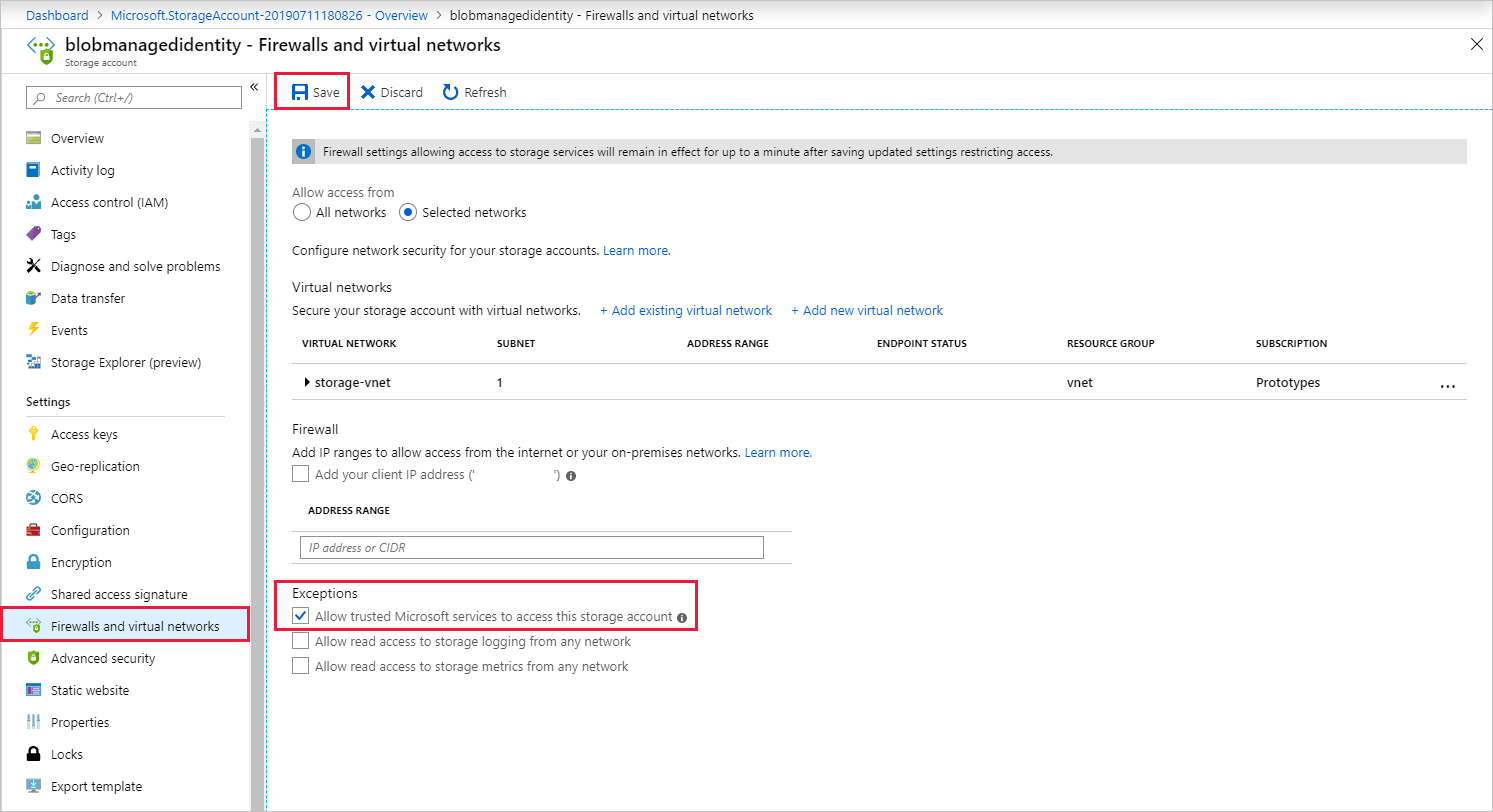
When you configure your storage account's Firewalls and virtual networks, you can optionally allow in network traffic from other trusted Microsoft services. When Stream Analytics authenticates by using Managed Identity, it provides proof that the request is originating from a trusted service. The following instructions explain how to enable this virtual network access exception.
- Go to the Firewalls and virtual networks pane within the storage account's configuration pane.
- Ensure the Allow trusted Microsoft services to access this storage account option is enabled.
- If you enabled it, select Save.
Remove Managed Identity
The Managed Identity you create for a Stream Analytics job is deleted only when you delete the job. You can't delete the Managed Identity without deleting the job. If you no longer want to use the Managed Identity, you can change the authentication method for the output. The Managed Identity continues to exist until you delete the job, and it's used if you decide to use Managed Identity authentication again.
Limitations
The current limitations of this feature include:
Classic Azure Storage accounts.
Azure accounts without Microsoft Entra ID.
Multitenant access isn't supported. The service principal created for a given Stream Analytics job must reside in the same Microsoft Entra tenant in which you created the job, and you can't use it with a resource that resides in a different Microsoft Entra tenant.