Hinweis
Für den Zugriff auf diese Seite ist eine Autorisierung erforderlich. Sie können versuchen, sich anzumelden oder das Verzeichnis zu wechseln.
Für den Zugriff auf diese Seite ist eine Autorisierung erforderlich. Sie können versuchen, das Verzeichnis zu wechseln.
[The TCP chimney offload feature is deprecated and should not be used.]
When propagating a state-manipulation operation, an intermediate driver overlays most of the members of an incoming NDIS_MINIPORT_OFFLOAD_BLOCK_LIST structure onto an NDIS_PROTOCOL_OFFLOAD_BLOCK_LIST structure. (For a comparison of these structures, see Comparison of Offload Block List Types.)
The intermediate driver must also store the ImReserved and SourceHandle members of the NDIS_MINIPORT_OFFLOAD_BLOCK_LIST structure, as shown in the following figure.
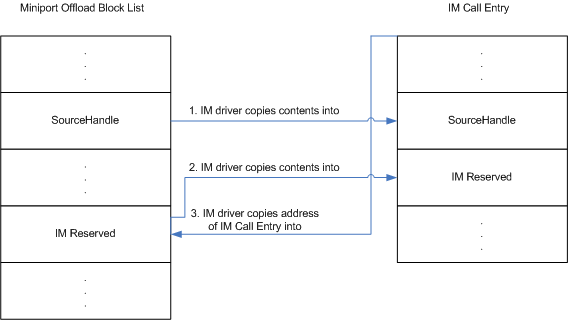
After its MiniportXxxOffload function is called, the intermediate driver creates a context, called an IM call entry, for the state-manipulation operation. This context is valid only for the duration of the state-manipulation operation.
The intermediate driver copies the ImReserved and SourceHandle members from the incoming NDIS_MINIPORT_OFFLOAD_BLOCK_LIST structure into its IM call entry. (When completing the state-manipulation operation, the intermediate driver will copy the contents of the stored ImReserved and SourceHandle members into the ImReserved and SourceHandle members of the NDIS_MINIPORT_OFFLOAD_BLOCK_LIST structure that it passes to the NdisMXxxComplete function.)
The intermediate driver writes a pointer into the ImReserved member of the NDIS_MINIPORT_OFFLOAD_BLOCK_LIST structure. This pointer points to the IM call entry. (When completing the state-manipulation operation, the intermediate driver will use this pointer to locate the IM call entry for the state-manipulation operation.)
When calling the NdisXxxOffload function to propagate the operation to the underlying driver, the intermediate driver passes a pointer to the newly constructed NDIS_PROTOCOL_OFFLOAD_BLOCK_LIST structure.