Bemærk
Adgang til denne side kræver godkendelse. Du kan prøve at logge på eller ændre mapper.
Adgang til denne side kræver godkendelse. Du kan prøve at ændre mapper.
Priority processing provides low-latency performance with the flexibility of pay-as-you-go. In this article, you enable priority processing on a model deployment, verify which service tier processed your requests, and monitor associated costs.
Prerequisites
- An Azure subscription - Create one for free.
- A Microsoft Foundry project with a model of the deployment type
GlobalStandardorDataZoneStandarddeployed. - Model versions
2025-12-01or later.
Key use cases
- Consistent, low latency for responsive user experiences.
- Pay-as-you-go simplicity with no long-term commitments.
- Business-hour or bursty traffic that benefits from scalable, cost-efficient performance. Optionally, you can combine priority processing with Provisioned Throughput Units (PTU) for steady-state capacity and cost optimization.
Latency target
| Model | Latency target value2 |
|---|---|
| gpt-5.4, 2026-03-051 | 99% > 50 Tokens Per Second |
| gpt-5.2, 2025-12-11 | 99% > 50 Tokens Per Second |
| gpt-5.1, 2025-11-13 | 99% > 50 Tokens Per Second |
| gpt-4.1, 2025-04-141 | 99% > 80 Tokens Per Second |
1 Long context requests (that is, requests estimated at larger than 128k prompt tokens) will be downgraded to standard processing and you'll be charged at the standard tier rate.
2 Calculated as p50 request latency on a per 5 minute basis.
Priority processing availability by deployment type
Priority processing can be enabled in Global standard deployments or Data Zone standard (US) deployments. For pricing information, see the Azure OpenAI pricing page.
Global standard model availability
| Region | gpt-5.5, 2026-04-24 | gpt-5.4-mini, 2026-03-17 | gpt-5.4, 2026-03-05 | gpt-5.2, 2025-12-11 | gpt-5.1, 2025-11-13 | gpt-4.1, 2025-04-14 |
|---|---|---|---|---|---|---|
| australiaeast | - | ✅ | ✅ | ✅ | ✅ | ✅ |
| brazilsouth | - | ✅ | ✅ | ✅ | ✅ | ✅ |
| canadacentral | - | ✅ | ✅ | ✅ | ✅ | ✅ |
| canadaeast | - | ✅ | ✅ | ✅ | ✅ | ✅ |
| centralus | - | ✅ | ✅ | ✅ | ✅ | ✅ |
| eastus | - | ✅ | ✅ | ✅ | ✅ | ✅ |
| francecentral | - | ✅ | ✅ | ✅ | ✅ | ✅ |
| germanywestcentral | - | ✅ | ✅ | ✅ | ✅ | ✅ |
| italynorth | - | ✅ | ✅ | ✅ | ✅ | ✅ |
| japaneast | - | ✅ | ✅ | ✅ | ✅ | ✅ |
| koreacentral | - | ✅ | ✅ | ✅ | ✅ | ✅ |
| northcentralus | - | ✅ | ✅ | ✅ | ✅ | ✅ |
| norwayeast | - | ✅ | ✅ | ✅ | ✅ | ✅ |
| polandcentral | ✅ | ✅ | ✅ | ✅ | ✅ | ✅ |
| southafricanorth | - | ✅ | ✅ | ✅ | ✅ | ✅ |
| southcentralus | ✅ | ✅ | ✅ | ✅ | ✅ | ✅ |
| southeastasia | - | ✅ | ✅ | ✅ | ✅ | ✅ |
| southindia | - | ✅ | ✅ | ✅ | ✅ | ✅ |
| spaincentral | - | ✅ | ✅ | ✅ | ✅ | ✅ |
| swedencentral | ✅ | ✅ | ✅ | ✅ | ✅ | ✅ |
| switzerlandnorth | - | ✅ | ✅ | ✅ | ✅ | ✅ |
| switzerlandwest | - | ✅ | ✅ | ✅ | ✅ | ✅ |
| uaenorth | - | ✅ | ✅ | ✅ | ✅ | ✅ |
| uksouth | - | ✅ | ✅ | ✅ | ✅ | ✅ |
| westeurope | - | ✅ | ✅ | ✅ | ✅ | ✅ |
| westus | - | ✅ | ✅ | ✅ | ✅ | ✅ |
| westus3 | - | ✅ | ✅ | ✅ | ✅ | ✅ |
Enable priority processing at the deployment level
You can enable priority processing at the deployment level and (optionally) at the request level.
Note
Priority processing can be enabled in Global standard or Data Zone standard (US) deployments. Priority processing uses the same quota as standard processing.
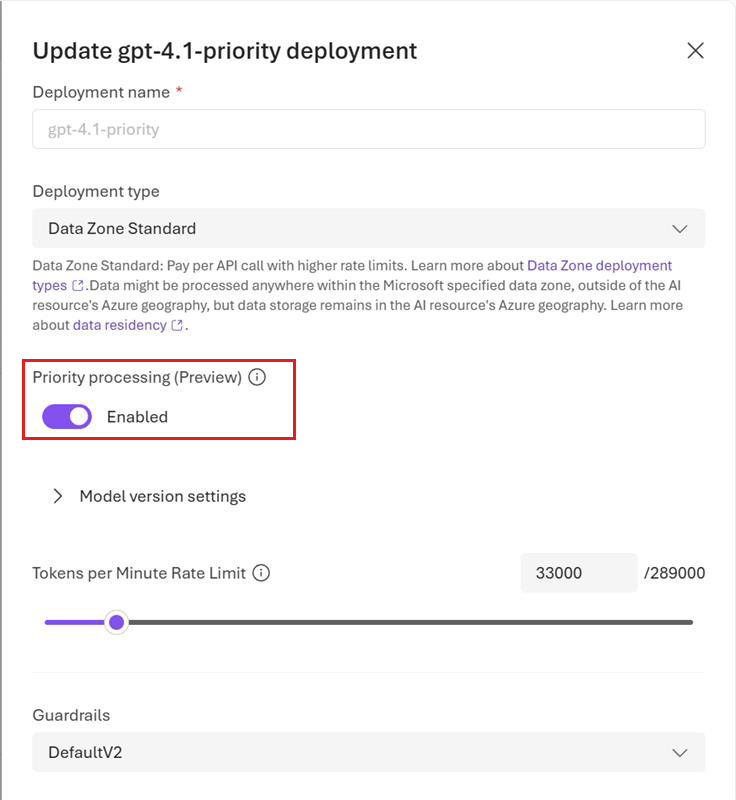
In the Microsoft Foundry portal, turn on the Priority processing toggle on the deployment details page when creating the deployment or update the setting of a deployed model by editing the deployment details.
Note
If you prefer to use code to enable priority processing at the deployment level, you can do so via the REST API for deployment by setting the service_tier attribute as follows: "properties" : {"service_tier" : "priority"}. Allowed values for the service_tier attribute are default and priority. default implies standard processing, while priority enables priority processing.
Once a model deployment is configured to use priority processing, you can start sending requests to the model.
View usage metrics
You can view the utilization measure for your resource in the Azure Monitor section in the Azure portal.
To view the volume of requests processed by standard processing versus priority processing, split by the service tier (standard or priority) that was in the original request:
- Sign in to https://portal.azure.com.
- Go to your Azure OpenAI resource and select the Metrics option from the left navigation.
- On the metrics page, add the Azure OpenAI requests metric. You can also select other metrics like Azure OpenAI latency, Azure OpenAI usage, and others.
- Select Add filter to select the standard deployment for which priority processing requests were processed.
- Select Apply splitting to split the values by ServiceTierRequest and ServiceTierResponse.

For more information about monitoring your deployments, see Monitor Azure OpenAI.
Monitor costs
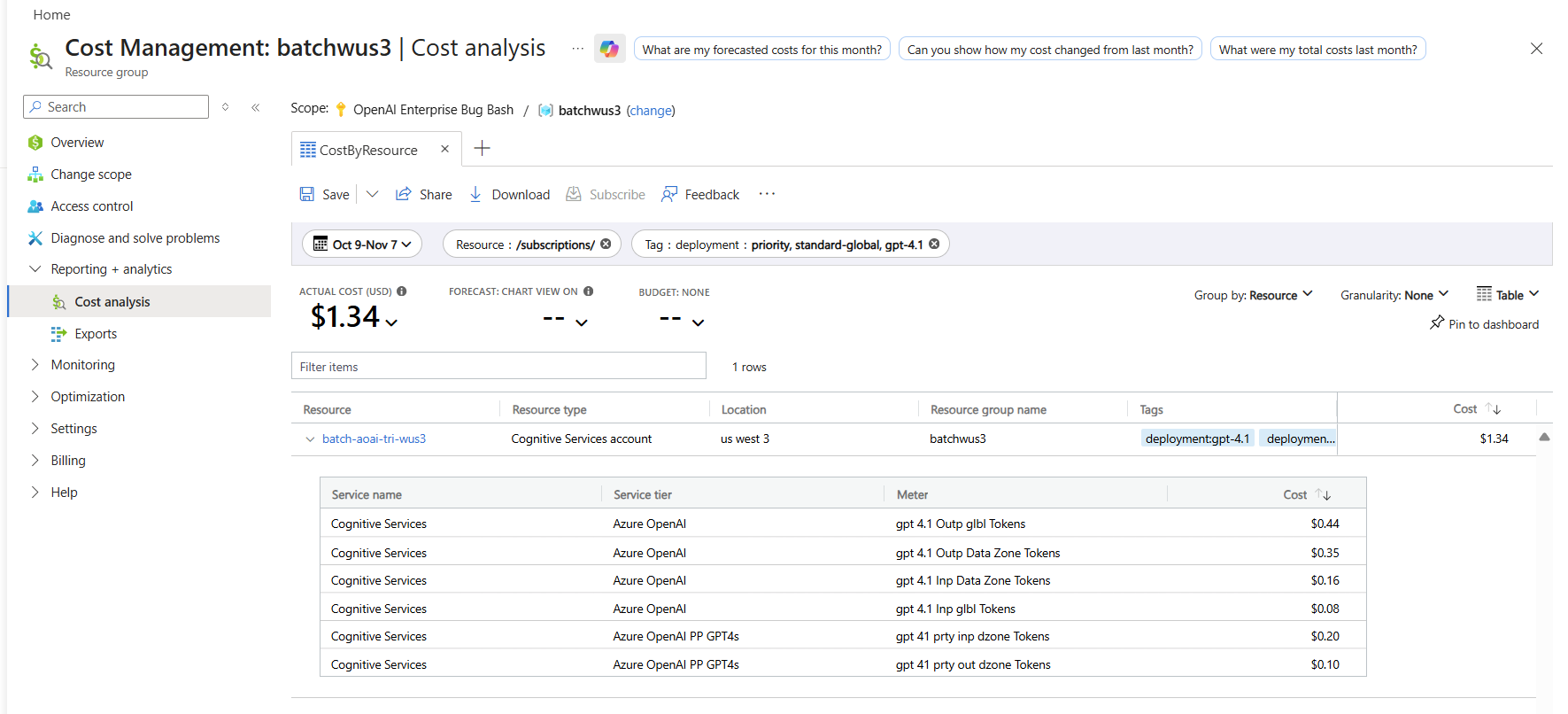
You can see a breakdown of costs for priority and standard requests in the Azure portal's cost analysis page by filtering on deployment name and billing tags as follows:
- Go to the cost analysis page in the Azure portal.
- (Optional) Filter by resource.
- To filter by deployment name: Add a filter for billing Tag > select deployment as the value, then choose your deployment name.
For information about pricing for priority processing, see the Azure OpenAI Service pricing overview.
Enable priority processing at the request level
Enabling priority processing at the request level is optional. Both the chat completions API and responses API have an optional attribute service_tier that specifies the processing type to use when serving a request. The following example shows how to set service_tier to priority in a responses request.
curl -X POST https://YOUR-RESOURCE-NAME.openai.azure.com/openai/v1/responses \
  -H "Content-Type: application/json" \
  -H "Authorization: Bearer $AZURE_OPENAI_AUTH_TOKEN" \
  -d '{
     "model": "gpt-4.1",
     "input": "This is a test",
     "service_tier": "priority"
    }'
Use the service_tier attribute to override the deployment-level setting. service_tier can take the values auto, default, and priority.
If you don't set the attribute, it defaults to
auto.service_tier = automeans the request uses the service tier configured in the deployment.service_tier = defaultmeans the request uses the standard pricing and performance for the selected model.service_tier = prioritymeans the request uses the priority processing service tier.
The following table summarizes which service tier processes your requests based on the deployment-level and request-level settings for service_tier.
| Deployment-level setting | Request-level setting | Request processed by service tier |
|---|---|---|
| default | auto, default | Standard |
| default | priority | Priority processing |
| priority | auto, priority | Priority processing |
| priority | default | Standard |
Limitations
The service currently doesn't support regional standard deployments and EU datazone standard deployments.
The service might re-route some priority requests to standard processing* during these scenarios:
- If rapid increases to your priority processing tokens per minute lead to hitting ramp rate limits. Currently, the ramp rate limit is defined as increasing traffic by more than 50% tokens per minute in less than 15 minutes.
- During periods of peak requests to priority processing.
- Long context requests sent to certain models listed in the Latency target table.
Tip
If you routinely encounter ramp rate limits, consider purchasing PTU instead of or in addition to priority processing.
* The service bills requests processed by the standard service tier at standard rates. Requests processed by the standard service tier include
service_tier = defaultin the response, while requests processed by priority processing tier includeservice_tier = priorityin the response.
Troubleshooting
| Issue | Cause | Resolution |
|---|---|---|
| Requests downgraded to standard tier | One of these situations: - Traffic ramped up more than 50% tokens per minute in under 15 minutes, hitting the ramp rate limit. - Requests sent during periods of peak requests to priority processing. - Long context requests sent to certain models listed in the Latency target table. |
- Increase traffic gradually, if you've encountered ramp rate limits. - Consider purchasing PTU for steady-state capacity. |