Bemærk
Adgang til denne side kræver godkendelse. Du kan prøve at logge på eller ændre mapper.
Adgang til denne side kræver godkendelse. Du kan prøve at ændre mapper.
Important
Items marked (preview) in this article are currently in public preview. This preview is provided without a service-level agreement, and we don't recommend it for production workloads. Certain features might not be supported or might have constrained capabilities. For more information, see Supplemental Terms of Use for Microsoft Azure Previews.
A single agent can depend on multiple tools - APIs, Model Context Protocol (MCP) servers, connectors, and flows - each with its own authentication model and owning team. As you scale across an organization, teams re-implement the same tools independently, credentials get duplicated, governance becomes inconsistent, and there's little visibility into what tools exist or who's using them. Developers stall, not because the models aren't capable, but because tool integration becomes the bottleneck.

Enterprises already have the infrastructure: gateways, credential vaults, policies, and observability. What's been missing is a developer experience that packages this infrastructure into something reusable, discoverable, and governed by default.
Toolbox provides that experience. Define a curated set of tools once, manage them centrally in Foundry, and expose them through a single MCP-compatible endpoint that any agent can consume. The platform handles credential injection, token refresh, and enterprise policy enforcement at runtime.
Toolbox covers the full tool lifecycle through four pillars - Build and Consume are available today:
| Pillar | Status | What it enables |
|---|---|---|
| Build | Available today | Select tools, configure authentication centrally, and publish a reusable toolbox that any team can consume. |
| Consume | Available today | Connect any agent to a single MCP-compatible endpoint to dynamically discover and invoke all tools in the toolbox. |

You create toolboxes in Foundry, but the consumption surface is open. Any MCP-compatible agent runtime or client can use a toolbox - including agents built with any framework, MCP-enabled IDEs, and custom code.
Because a toolbox is a managed resource, you can add, remove, or reconfigure tools without changing code in your agent. Your agent always connects to a single endpoint. Toolbox versioning gives you explicit control over when changes take effect - create and test a new version, then promote it to default when you're ready. Every agent that points to the toolbox picks up the promoted version automatically, with no code changes and no redeployment.
In this article, you learn how to:
- Create a toolbox with one or more tools.
- Get the toolbox MCP endpoint.
- Verify that tools load correctly.
- Integrate a toolbox into your hosted agent.
- Manage toolbox versions and promote a version to default.
For tool configuration syntax and authentication options for each tool type, see Configure tools.
Feature support
| Feature | Python SDK | REST API | .NET SDK | JavaScript SDK | azd (deploy) | Foundry Toolkit |
|---|---|---|---|---|---|---|
| Toolbox update, list, get, and delete | ✔️ | ✔️ | ✔️ | ✔️ | N/A | ✔️ |
| Toolbox version create | ✔️ | ✔️ | ✔️ | ✔️ | ✔️ | ✔️ |
| Toolbox version list, get, and delete | ✔️ | ✔️ | ✔️ | ✔️ | N/A | No. UI shows the latest version only. |
| MCP tool | ✔️ | ✔️ | ✔️ | ✔️ | ✔️ | ✔️ |
| Web Search tool | ✔️ | ✔️ | ✔️ | ✔️ | ✔️ | ✔️ |
| Azure AI Search tool | ✔️ | ✔️ | ✔️ | ✔️ | ✔️ | ✔️ |
| Code Interpreter tool | ✔️ | ✔️ | ✔️ | ✔️ | ✔️ | ✔️ |
| File Search tool | ✔️ | ✔️ | ✔️ | ✔️ | ✔️ | ✔️ |
| OpenAPI tool | ✔️ | ✔️ | ✔️ | ✔️ | ✔️ | No |
| Agent-to-Agent (A2A) tool | ✔️ | ✔️ | ✔️ | ✔️ | ✔️ | No |
Prerequisites
- An active Microsoft Foundry project.
- RBAC: Grant the Azure AI User role on the Foundry project to each identity that applies to your scenario:
- Developer (always required) — the identity that creates, updates, and manages toolbox versions.
- Agent identity (required if using a hosted agent) — the agent's managed identity that calls tools at runtime.
- End user (required only for OAuth flows) — any user whose identity is proxied through OAuth or UserEntraToken connections (for example, OAuth-based MCP or 1P OBO flows).
- Your Foundry project needs to be at one of the supported regions. Individual tool types within a toolbox are further limited by region and model – not all tool types are available in every region or with every model. See Region and model compatibility.
- Visual Studio Code (VS Code).
- Install the Microsoft Foundry Toolkit for Visual Studio Code (formerly AI Toolkit for VS Code) from the Visual Studio Code Marketplace. Toolbox support in Foundry Toolkit is currently in preview.
- Python SDK:
pip install azure-ai-projects azure-identity - .NET SDK:
dotnet add package Azure.AI.Projects --prereleaseanddotnet add package Azure.Identity - JavaScript SDK:
npm install @azure/ai-projects @azure/identity - azd (deploy): Install the Azure Developer CLI and the agent extension:
azd extension install azure.ai.agents
Important
- A toolbox supports at most one tool without a
namefield per tool type (Web Search, Azure AI Search, Code Interpreter, File Search). To include more than one instance of the same tool type, set a uniquenameon each instance to differentiate them. Including two instances of the same type without anamereturns aninvalid_payloaderror. For details, see Multiple tool types. - Add a
descriptionto every tool in your toolbox to help the model select the right tool for each request. - Carefully review each tool's documentation to learn more about individual tool setup, limitations, and warnings.
Step 1: Create a toolbox version
Create a toolbox version based on the tools you need.
from azure.identity import DefaultAzureCredential
from azure.ai.projects import AIProjectClient
from azure.ai.projects.models import MCPTool, WebSearchTool

# Create Foundry project client
endpoint = "https://<your-foundry-account>.services.ai.azure.com/api/projects/<your-project>"
project = AIProjectClient(
    endpoint=endpoint,
    credential=DefaultAzureCredential(),
)

# Create toolbox version with web search and MCP tools
toolbox_version = project.beta.toolboxes.create_toolbox_version(
    toolbox_name="my-toolbox",
    description="Toolbox with web search and an MCP server",
    tools=[
        WebSearchTool(),
        MCPTool(
            server_label="myserver",
            server_url="https://your-mcp-server.example.com",
            require_approval="never",
            project_connection_id="my-key-auth-connection",
        ),
    ],
)
print(f"Created toolbox: {toolbox_version.name}, version: {toolbox_version.version}")
using Azure.Identity;
using Azure.AI.Projects;

// Create Foundry project client
var projectEndpoint = "https://<your-foundry-account>.services.ai.azure.com/api/projects/<your-project>";
AIProjectClient projectClient = new(new Uri(projectEndpoint), new DefaultAzureCredential());
AgentToolboxes toolboxClient = projectClient.AgentAdministrationClient.GetAgentToolboxes();

ProjectsAgentTool webTool = ProjectsAgentTool.AsProjectTool(
    ResponseTool.CreateWebSearchTool());

ProjectsAgentTool mcpTool = ProjectsAgentTool.AsProjectTool(ResponseTool.CreateMcpTool(
    serverLabel: "myserver",
    serverUri: new Uri("https://your-mcp-server.example.com"),
    toolCallApprovalPolicy: new McpToolCallApprovalPolicy(
        GlobalMcpToolCallApprovalPolicy.NeverRequireApproval
    )
));

ToolboxVersion toolboxVersion = await toolboxClient.CreateToolboxVersionAsync(
    toolboxName: "my-toolbox",
    tools: [webTool, mcpTool],
    description: "Toolbox with web search and an MCP server"
);
Console.WriteLine($"Created toolbox: {toolboxVersion.Name}, version: {toolboxVersion.Version}");
POST {project_endpoint}/toolboxes/my-toolbox/versions?api-version=v1
Authorization: Bearer {token}
Content-Type: application/json

{
  "description": "Toolbox with web search and an MCP server",
  "tools": [
    {
      "type": "web_search",
      "description": "Search the web for current information"
    },
    {
      "type": "mcp",
      "server_label": "myserver",
      "server_url": "https://your-mcp-server.example.com",
      "require_approval": "never",
      "project_connection_id": "my-key-auth-connection"
    }
  ]
}
Note
Use token scope https://ai.azure.com/.default when getting the bearer token.
import { DefaultAzureCredential } from "@azure/identity";
import { AIProjectClient } from "@azure/ai-projects";

// Create Foundry project client
const projectEndpoint = "https://<your-foundry-account>.services.ai.azure.com/api/projects/<your-project>";

const project = new AIProjectClient(projectEndpoint, new DefaultAzureCredential());

const toolboxVersion = await project.beta.toolboxes.createVersion(
  "my-toolbox",
  [
    {
      type: "web_search",
      description: "Search the web for current information",
    },
    {
      type: "mcp",
      server_label: "myserver",
      server_url: "https://your-mcp-server.example.com",
      require_approval: "never",
      project_connection_id: "my-key-auth-connection",
    },
  ],
  {
    description: "Toolbox with web search and an MCP server",
  },
);
console.log(`Created toolbox: ${toolboxVersion.name}, version: ${toolboxVersion.version}`);
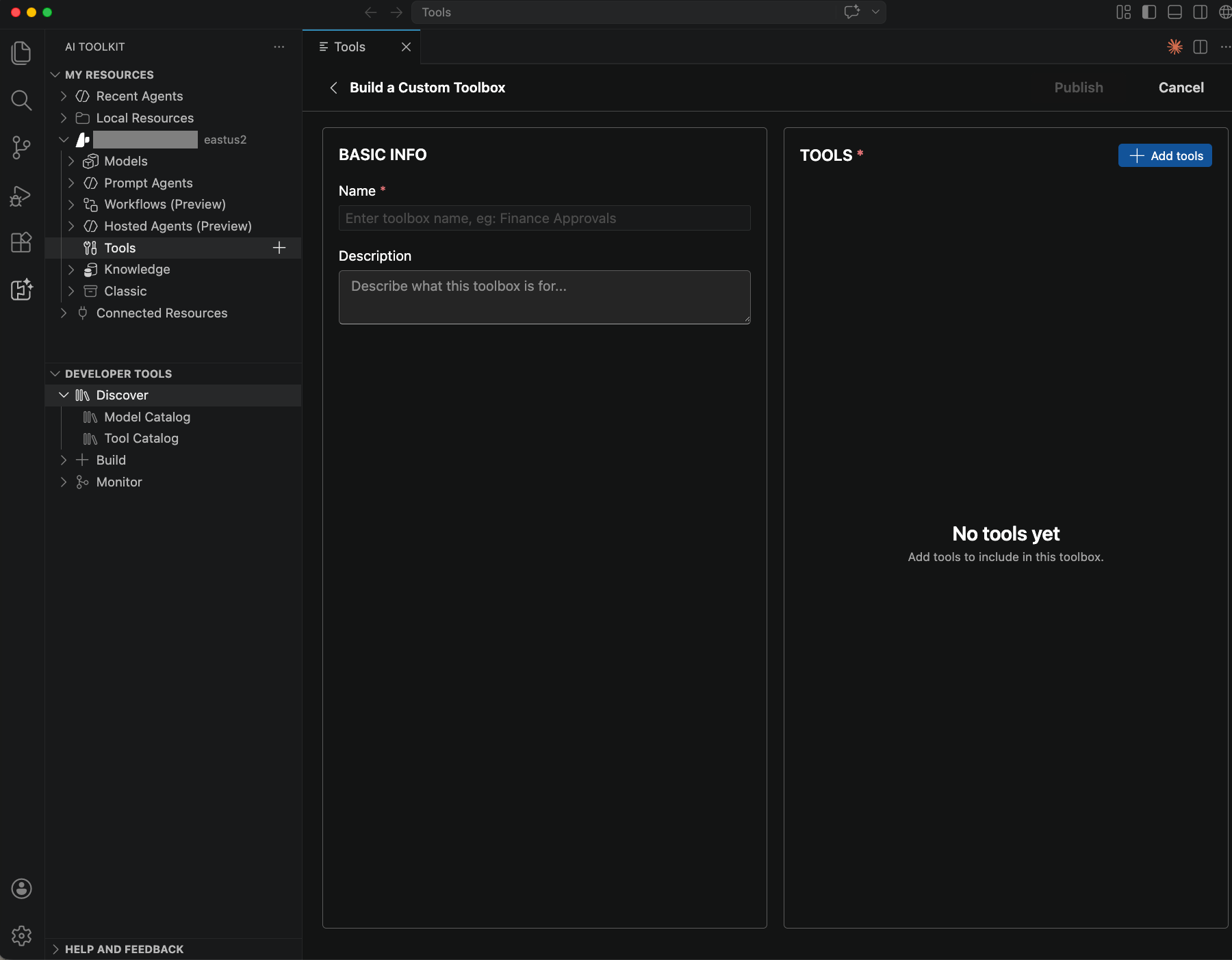
Use Foundry Toolkit in Visual Studio Code to create and publish a toolbox from the Tools view.
- Select Foundry Toolkit in the Activity Bar.
- Under My Resources, expand Your project name > Tools.
- Select the + Add Toolbox icon.
- On the Build a Custom Toolbox tab, enter the toolbox name and description, add the tools you want, and then select Publish.
Publishing a new toolbox creates its first version. That version becomes the default version automatically.
By using azd, you declare toolbox resources in an agent.yaml file instead of calling the SDK. Define your tools in the resources section and deploy by using azd ai agent init. For agent.yaml examples for each tool type, see Configure tools. For the full deployment workflow, see Deploy with azd.
Important
The -m (or --manifest) flag is required for azd ai agent init.
It tells the command where to find your agent definition and source files.
-m can point to either:
- A specific
agent.yamlfile — init copies all files from the same directory as the manifest - A folder containing
agent.yaml— init copies all files from that folder
All files in the manifest directory (main.py, Dockerfile, requirements.txt, setup.py, and so on)
are copied into the scaffolded project under src/<agent-name>/.
# 1. Create a manifest directory with your agent.yaml + source files
mkdir my-agent/manifest
# Copy agent.yaml, main.py, Dockerfile, requirements.txt into my-agent/manifest/

# 2. Initialize the azd project (note: -m is REQUIRED)
cd my-agent
$PROJECT_ID = "/subscriptions/<sub>/resourceGroups/<rg>/providers/Microsoft.CognitiveServices/accounts/<account>/projects/<project>"
azd ai agent init -m https://github.com/microsoft/hosted-agents-vnext-private-preview/main/samples/python/toolbox/azd/agent.yaml --project-id $PROJECT_ID -e my-env
# Or equivalently: azd ai agent init -m manifest/ --project-id $PROJECT_ID -e my-env
# ↑ If your agent.yaml declares {{ param }} secrets (e.g., github_pat), you will be prompted to enter
#   them interactively HERE — before init completes. This is the only safe time to supply credentials.
# NOTE: Do NOT use --no-prompt here — it skips the prompt and leaves {{ param }} credentials empty (see Troubleshooting: Credentials Empty with --no-prompt)

# 3. CRITICAL post-init fixes (see "Post-Init Checklist" below)
azd env set enableHostedAgentVNext "true" -e my-env
azd env set AZURE_AI_MODEL_DEPLOYMENT_NAME "gpt-4o" -e my-env  # must match the deployment name in azure.yaml

# 4. Provision infrastructure (creates connections via Bicep)
azd provision -e my-env

# 5. Deploy agent (creates toolboxes, container image, agent version)
azd deploy -e my-env

# 6. Invoke the agent (MUST run from the scaffolded project directory)
azd ai agent invoke --new-session "tell me about the latest news in Microsoft Foundry" --timeout 120
Agent.yaml:
kind: hosted
name: toolbox-azd-test
description: LangGraph agent wired for toolbox MCP.
metadata:
  tags:
    - AI Agent Hosting
    - LangGraph

# template: contains the ContainerAgent definition (kind: hosted).
# These fields are used to generate src/<agent>/agent.yaml during init.
template:
  kind: hosted
  protocols:
    - protocol: responses
      version: 1.0.0
  environment_variables:
    # FOUNDRY_PROJECT_ENDPOINT and FOUNDRY_AGENT_TOOLBOX_* are injected
    # automatically by the platform at runtime — do NOT declare them here.
    - name: AZURE_OPENAI_ENDPOINT
      value: ${AZURE_OPENAI_ENDPOINT}
    - name: AZURE_AI_MODEL_DEPLOYMENT_NAME
      value: ${AZURE_AI_MODEL_DEPLOYMENT_NAME=gpt-4o}
    - name: TOOLBOX_NAME
      value: ${TOOLBOX_NAME=agent-tools}

# parameters: secret values prompted at init time (or set via azd env).
# azd uppercases the param name to find the env var: github_pat → GITHUB_PAT.
parameters:
  github_pat:
    secret: true
    description: GitHub Personal Access Token (classic ghp_... or fine-grained github_pat_...)

# resources: connections and toolboxes scaffolded into azure.yaml by azd ai agent init.
resources:
  - kind: connection
    name: github-mcp-conn
    target: https://api.githubcopilot.com/mcp
    category: remoteTool
    credentials:
      type: CustomKeys
      keys:
        Authorization: "Bearer {{ github_pat }}"

  - kind: toolbox
    name: agent-tools
    tools:
      - type: web_search
      - type: mcp
        server_label: github
        server_url: https://api.githubcopilot.com/mcp
        project_connection_id: github-mcp-conn
Step 2: Get the toolbox MCP endpoint
Two endpoint patterns exist depending on your role:
| Role | Endpoint | When to use |
|---|---|---|
| Toolbox developer | {project_endpoint}/toolboxes/{toolbox_name}/versions/{version}/mcp?api-version=v1 |
Test or validate a specific version before promoting it to default. |
| Toolbox consumer | {project_endpoint}/toolboxes/{toolbox_name}/mcp?api-version=v1 |
Connect agents to the toolbox. Always serves the default_version. The first version you create is automatically set as the default. |
Important
Every request to the toolbox MCP endpoint must include the header Foundry-Features: Toolboxes=V1Preview. Calls that omit this header fail. Include it in all HTTP clients, MCP transports, and SDK wrappers that call the toolbox endpoint.
Note
The first version of a new toolbox is automatically promoted to default_version (v1). If you need to change the default later, see Promote a version to default.
In Foundry Toolkit for Visual Studio Code, copy the toolbox consumer endpoint from the Toolboxes view.
- Select Foundry Toolkit in the Activity Bar.
- Under My Resources, expand Your project name > Tools.
- On the Toolboxes tab, locate your toolbox.
- In the Endpoint URL column, copy the endpoint.
The Endpoint URL value is the toolbox consumer endpoint. To construct a version-specific endpoint, use the developer pattern shown in the previous table.

Step 3: Verify tool availability
Before running the full agent, confirm that the toolbox loads the expected tools by using an MCP client SDK against the endpoint. Use the version-specific endpoint to validate a version before promoting it to default.
Install the MCP client SDK:
pip install mcp
Connect to the toolbox and list tools
import asyncio
from azure.identity import DefaultAzureCredential
from mcp.client.streamable_http import streamablehttp_client
from mcp import ClientSession

url = "https://<account>.services.ai.azure.com/api/projects/<proj>/toolboxes/<name>/versions/<version>/mcp?api-version=v1"

token = DefaultAzureCredential().get_token("https://ai.azure.com/.default").token
headers = {
    "Authorization": f"Bearer {token}",
    "Foundry-Features": "Toolboxes=V1Preview",
}

async def verify_toolbox():
    async with streamablehttp_client(url, headers=headers) as (read, write, _):
        async with ClientSession(read, write) as session:
            await session.initialize()

            # List available tools
            tools_result = await session.list_tools()
            print(f"Tools found: {len(tools_result.tools)}")
            for tool in tools_result.tools:
                print(f"  - {tool.name}: {(tool.description or '')[:80]}")

            # Call a tool (replace with actual tool name and arguments)
            result = await session.call_tool("<tool_name>", arguments={})
            print(result)

asyncio.run(verify_toolbox())
Note
Use the REST API tab to verify tool availability from .NET, or use the Python MCP client SDK.
Use the version-specific endpoint (/versions/{version}/mcp) to validate a version before promoting it.
1. Initialize the MCP session:
POST {project_endpoint}/toolboxes/{toolbox_name}/versions/{version}/mcp?api-version=v1
Authorization: Bearer {token}
Content-Type: application/json
Foundry-Features: Toolboxes=V1Preview

{"jsonrpc":"2.0","id":1,"method":"initialize","params":{"protocolVersion":"2025-03-26","capabilities":{},"clientInfo":{"name":"test","version":"1.0"}}}
2. Send the initialized notification:
POST {project_endpoint}/toolboxes/{toolbox_name}/versions/{version}/mcp?api-version=v1
Authorization: Bearer {token}
Content-Type: application/json
Foundry-Features: Toolboxes=V1Preview

{"jsonrpc":"2.0","method":"notifications/initialized"}
3. List available tools:
POST {project_endpoint}/toolboxes/{toolbox_name}/versions/{version}/mcp?api-version=v1
Authorization: Bearer {token}
Content-Type: application/json
Foundry-Features: Toolboxes=V1Preview

{"jsonrpc":"2.0","id":2,"method":"tools/list","params":{}}
4. Call a tool:
POST {project_endpoint}/toolboxes/{toolbox_name}/versions/{version}/mcp?api-version=v1
Authorization: Bearer {token}
Content-Type: application/json
Foundry-Features: Toolboxes=V1Preview

{"jsonrpc":"2.0","id":3,"method":"tools/call","params":{"name":"<TOOL_NAME>","arguments":{}}}
Install the MCP client SDK:
npm install @modelcontextprotocol/sdk
Connect to the toolbox and list tools
import { DefaultAzureCredential } from "@azure/identity";
import { StreamableHTTPClientTransport } from "@modelcontextprotocol/sdk/client/streamableHttp.js";
import { Client } from "@modelcontextprotocol/sdk/client/index.js";

const url = "https://<account>.services.ai.azure.com/api/projects/<proj>/toolboxes/<name>/versions/<version>/mcp?api-version=v1";

const credential = new DefaultAzureCredential();
const token = await credential.getToken("https://ai.azure.com/.default");

const transport = new StreamableHTTPClientTransport(
  new URL(url),
  {
    requestInit: {
      headers: {
        Authorization: `Bearer ${token.token}`,
        "Foundry-Features": "Toolboxes=V1Preview",
      },
    },
  },
);

const client = new Client({ name: "test", version: "1.0" });
await client.connect(transport);

// List available tools
const toolsResult = await client.listTools();
console.log(`Tools found: ${toolsResult.tools.length}`);
for (const tool of toolsResult.tools) {
  console.log(`  - ${tool.name}: ${(tool.description || "").slice(0, 80)}`);
}

// Call a tool (replace with actual tool name and arguments)
const result = await client.callTool({ name: "<tool_name>", arguments: {} });
console.log(result);

await client.close();
Use the endpoint from Step 2 together with a scaffolded hosted agent sample to validate toolbox loading in VS Code.
- In Foundry Toolkit, under My Resources > Your project name > Tools, locate the toolbox you want to test.
- Select Scaffold code template.
- Choose a project folder when prompted.
- Follow the generated
README.mdto install dependencies, configure environment variables, and run the sample locally. - Use Agent Inspector or run
python main.pyto confirm the toolbox tools load and respond.
For version-specific validation before you promote a new toolbox version, use the Python or REST API tab in this step.
Note
Use the REST API tab to verify tool availability, or use the Python MCP client SDK.
Check — initialize: HTTP 200. If you skip the initialize step, subsequent calls fail.
Check — tools/list:
len(tools) > 0— empty means the toolbox version wasn't provisioned correctly.- Each tool has
name,description, andinputSchema. For tool naming conventions, see the MCP specification. inputSchemahas apropertiesfield (some MCP servers omit this field, which breaks OpenAI).- For MCP tools, names are prefixed with the
server_label- for example,myserver.some_tool. For all other tool types, the name is thenamefield value or the default tool name. - MCP tools include a
_meta.tool_configurationblock containing runtime settings such asrequire_approval. See Handle tool approval requirements. - Note the exact parameter names for the call step (for example
queryvsqueries).
Check - tools/call:
- No top-level
errorfield. If present, inspecterror.code. For standard MCP error codes, see the MCP specification:-32006→ OAuth consent required (extract URL fromerror.message).- Other codes → server-side failure.
result.content[]contains entries with"type": "text"- this is the tool output.- For AI Search, check
result.structuredContent.documents[]for chunk metadata (title,url,id,score). - For File Search, check
result.content[].resource._metafor chunk metadata (title,file_id,document_chunk_id,score). - For Web Search, check
result.content[].resource._meta.annotations[]for URL citations (type,url,title,start_index,end_index). - Watch for
"ServerError"in text content - the tool executed but hit an internal error.
Tool-specific tools/call argument examples:
| Tool type | Arguments |
|---|---|
| AI Search | {"query": "search text"} |
| File Search | {"queries": ["search text"]} |
| Code Interpreter | {"code": "print(2 ** 100)"} |
| Web Search | {"search_query": "weather in seattle"} |
| A2A | {"message": {"parts": [{"type": "text", "text": "Hello"}]}} |
| MCP | {"query": "what is agent service"} |
Step 4: Integrate the toolbox into your agent
LangGraph
.env file:
FOUNDRY_PROJECT_ENDPOINT=https://<account>.services.ai.azure.com/api/projects/<project>
FOUNDRY_AGENT_TOOLBOX_ENDPOINT=https://<account>.services.ai.azure.com/api/projects/<project>/toolboxes/<toolbox-name>/versions/<version>/mcp?api-version=v1
TOOLBOX_NAME=agent-tools
FOUNDRY_AGENT_TOOLBOX_FEATURES=Toolboxes=V1Preview
AZURE_AI_MODEL_DEPLOYMENT_NAME=gpt-4o
main.py (key pattern):
from langchain_azure_ai.tools import AzureAIProjectToolbox

toolbox = AzureAIProjectToolbox(toolbox_name=TOOLBOX_NAME)
tools = await toolbox.get_tools()
See the full sample for the complete implementation.
Important
Class langchain_azure_ai.tools.AzureAIProjectToolbox requires langchain-azure-ai[tools]>1.2.3.
Microsoft Agent Framework
Use MCPStreamableHTTPTool from the Agent Framework SDK to connect directly to the toolbox MCP endpoint.
.env file:
FOUNDRY_PROJECT_ENDPOINT=https://<account>.services.ai.azure.com/api/projects/<project>
FOUNDRY_AGENT_TOOLBOX_ENDPOINT=https://<account>.services.ai.azure.com/api/projects/<project>/toolboxes/<toolbox-name>/versions/<version>/mcp?api-version=v1
FOUNDRY_AGENT_TOOLBOX_FEATURES=Toolboxes=V1Preview
AZURE_AI_MODEL_DEPLOYMENT_NAME=gpt-4o
main.py (key pattern):
# Auth: wrap token provider in an httpx.Auth subclass
credential = DefaultAzureCredential()
token_provider = get_bearer_token_provider(credential, "https://ai.azure.com/.default")
http_client = httpx.AsyncClient(
    auth=_ToolboxAuth(token_provider),
    headers={"Foundry-Features": "Toolboxes=V1Preview"},
    timeout=120.0,
)

# Toolbox MCP endpoint (platform-injected at runtime via FOUNDRY_AGENT_TOOLBOX_ENDPOINT)
TOOLBOX_ENDPOINT = "https://<account>.services.ai.azure.com/api/projects/<project>/toolboxes/<toolbox-name>/versions/<version>/mcp?api-version=v1"

# Connect MCPStreamableHTTPTool to the toolbox endpoint
mcp_tool = MCPStreamableHTTPTool(
    name="toolbox",
    url=TOOLBOX_ENDPOINT,
    http_client=http_client,
    load_prompts=False,
)

agent = chat_client.as_agent(
    name="my-toolbox-agent",
    instructions="You are a helpful assistant with access to Foundry toolbox tools.",
    tools=[mcp_tool],
)
ResponsesAgentServerHost().run()
See the full sample for the complete implementation.
Copilot SDK
Use the GitHub Copilot SDK to build a toolbox-powered agent that bridges Copilot's tool invocation to the Foundry toolbox MCP endpoint.
Note
The Copilot SDK rejects tool names containing dots. The bridge automatically replaces . with _ in tool names. For example, myserver.get_info becomes myserver_get_info.
.env file:
GITHUB_TOKEN=<your-github-token>
FOUNDRY_AGENT_TOOLBOX_ENDPOINT=https://<account>.services.ai.azure.com/api/projects/<project>/toolboxes/<toolbox-name>/versions/<version>/mcp?api-version=v1
agent.py (key pattern — MCP bridge):
# 1. Open an MCP session to the toolbox endpoint
bridge = McpBridge(endpoint=TOOLBOX_ENDPOINT, token=_get_toolbox_token())
await bridge.initialize()
mcp_tools = await bridge.list_tools()

# 2. Map MCP tool list to Copilot SDK tool definitions
#    Dots in tool names are replaced with underscores (Copilot SDK requirement)
copilot_tools = [
    {
        "name": t["name"].replace(".", "_"),
        "description": t.get("description", ""),
        "parameters": t.get("inputSchema", {}),
    }
    for t in mcp_tools
]

# 3. Wire tool calls back to the MCP session
async def tool_handler(name: str, arguments: dict) -> str:
    return await bridge.call_tool(name.replace("_", ".", 1), arguments)

# 4. Run the Copilot SDK agent
agent = Agent(
    tools=copilot_tools,
    tool_handler=tool_handler,
    token=os.environ["GITHUB_TOKEN"],
)
See the full sample for the complete implementation.
Microsoft Agent Framework
Use ResponsesServer from the Agent Framework SDK with a custom ToolboxMcpClient to discover and invoke toolbox tools through the MCP endpoint.
Environment variables:
AZURE_OPENAI_ENDPOINT=https://<account>.services.ai.azure.com
AZURE_AI_MODEL_DEPLOYMENT_NAME=gpt-4o
TOOLBOX_MCP_ENDPOINT=https://<account>.services.ai.azure.com/api/projects/<project>/toolboxes/<toolbox-name>/versions/<version>/mcp?api-version=v1
Program.cs (key pattern):
using Azure.AI.AgentServer.Responses;
using Azure.AI.AgentServer.Responses.Models;
using Azure.AI.OpenAI;
using Azure.Identity;
using Microsoft.Extensions.DependencyInjection;
using OpenAI.Chat;

// Azure OpenAI endpoint and model deployment
var openAiEndpoint = "https://<account>.services.ai.azure.com";
var deployment = "gpt-4o";  // supports all toolbox tool types

// Toolbox MCP endpoint (platform-injected at runtime via TOOLBOX_MCP_ENDPOINT)
var toolboxEndpoint = "https://<account>.services.ai.azure.com/api/projects/<project>/toolboxes/<toolbox-name>/versions/<version>/mcp?api-version=v1";

// Azure OpenAI client
var credential = new DefaultAzureCredential();
var openAIClient = new AzureOpenAIClient(new Uri(openAiEndpoint), credential);
var chatClient = openAIClient.GetChatClient(deployment);

// Toolbox MCP client — discovers tools via tools/list, calls them via tools/call
var toolboxClient = new ToolboxMcpClient(toolboxEndpoint, credential);

ResponsesServer.Run<ToolboxHandler>(configure: builder =>
{
    builder.Services.AddSingleton(new AgentConfig(chatClient, toolboxClient));
});
ToolboxMcpClient wraps direct JSON-RPC calls to the MCP endpoint. ToolboxHandler connects LLM tool calls back to the MCP client by using a standard tool-calling loop. For the complete implementation of both classes, see the full sample.
Note
Integration samples for this step are available for Python and .NET only.
Note
Integration samples for this step are available for Python and .NET only.
Use Foundry Toolkit to scaffold a hosted agent sample that's already wired to your toolbox.
- Select Foundry Toolkit in the Activity Bar.
- Under My Resources, expand Your project name > Tools.
- On the Toolboxes tab, locate the toolbox you want to consume, and then select Scaffold code template.
- In the Command Palette, choose a project folder when prompted.
- Open the generated
README.mdand follow the setup, local run, and deployment steps for the scaffold.
The generated project includes the hosted agent entry point, deployment files, and a README.md with the exact setup, run, and deployment steps. The scaffolded agent handles the Foundry-Features: Toolboxes=V1Preview header for you.
If you want to integrate a toolbox into an existing hosted agent project instead of generating a new sample, use the copied endpoint from Step 2 with the Python or .NET patterns in this section.
Deploy with azd
Use the Azure Developer CLI (azd) to declare toolbox resources directly in an agent.yaml file and deploy your agent with a single command. By using this approach, you don't need to create the toolbox separately through SDK or REST. azd provisions the toolbox, connections, and model deployment together.
Important
The -m (or --manifest) flag is required for azd ai agent init. It tells the command where to find your agent definition and source files. -m can point to either a specific agent.yaml file or a folder containing one. All files in the manifest directory (main.py, Dockerfile, requirements.txt, and so on) are copied verbatim into the scaffolded project under src/<agent-name>/.
Folder structure:
my-agent/
├── agent.yaml          # Agent, toolbox, and connection declarations
├── main.py             # LangGraph agent
├── requirements.txt    # All dependencies (Azure SDK + PyPI packages)
├── Dockerfile          # Container build
agent.yaml (Web Search + GitHub MCP example):
name: my-toolbox-agent
description: LangGraph agent with Azure AI Foundry toolbox MCP.
metadata:
  tags:
    - AI Agent Hosting
    - LangGraph
template:
  name: my-toolbox-agent
  kind: hosted
  protocols:
    - protocol: responses
      version: 1.0.0
  environment_variables:
    # FOUNDRY_PROJECT_ENDPOINT and FOUNDRY_AGENT_TOOLBOX_* are injected
    # automatically by the platform at runtime — do NOT declare them here.
    - name: AZURE_AI_MODEL_DEPLOYMENT_NAME
      value: ${AZURE_AI_MODEL_DEPLOYMENT_NAME=gpt-4o}
    - name: TOOLBOX_NAME
      value: ${TOOLBOX_NAME=agent-tools}
parameters:
  github_pat:
    secret: true
    description: GitHub Personal Access Token for MCP connection
resources:
  - kind: connection
    name: github-mcp-conn
    target: https://api.githubcopilot.com/mcp
    category: RemoteTool
    authType: CustomKeys
    credentials:
      keys:
        Authorization: "Bearer {{ github_pat }}"
  - kind: toolbox
    name: agent-tools
    description: Web search and GitHub MCP tools
    tools:
      - type: web_search
      - type: mcp
        server_label: github
        server_url: https://api.githubcopilot.com/mcp
        project_connection_id: github-mcp-conn
Note
When you deploy with toolbox resources in agent.yaml, the platform injects FOUNDRY_AGENT_TOOLBOX_ENDPOINT (base URL) and TOOLBOX_{toolbox_name}_MCP_ENDPOINT (full per-toolbox endpoint) as environment variables. For the toolbox named agent-tools, the per-toolbox variable becomes TOOLBOX_AGENT_TOOLS_MCP_ENDPOINT. Your main.py reads the per-toolbox variable or constructs the URL from FOUNDRY_AGENT_TOOLBOX_ENDPOINT and TOOLBOX_NAME at runtime.
main.py follows the same LangGraph pattern shown earlier. By using azd, FOUNDRY_AGENT_TOOLBOX_ENDPOINT and TOOLBOX_{toolbox_name}_MCP_ENDPOINT are injected automatically - no extra endpoint configuration is needed in code.
Deploy:
# 1. Place agent.yaml and source files in a manifest directory
mkdir my-agent/manifest
# Copy agent.yaml, main.py, Dockerfile, requirements.txt into my-agent/manifest/

# 2. Initialize the azd project (-m is required)
cd my-agent
PROJECT_ID="/subscriptions/<sub>/resourceGroups/<rg>/providers/Microsoft.CognitiveServices/accounts/<account>/projects/<project>"
azd ai agent init -m manifest/ --project-id $PROJECT_ID -e my-env
# If agent.yaml declares {{ param }} secrets (for example, github_pat), you are prompted
# to enter them interactively here. Do NOT use --no-prompt — it leaves credentials empty.

# 3. Set required environment variables
azd env set enableHostedAgentVNext "true" -e my-env
azd env set AZURE_AI_MODEL_DEPLOYMENT_NAME "gpt-4o" -e my-env

# 4. Provision infrastructure (creates connections via Bicep)
azd provision -e my-env

# 5. Deploy agent (creates toolboxes, container image, agent version)
azd deploy -e my-env

# 6. Invoke the agent
azd ai agent invoke --new-session "Hello, what tools do you have?" --timeout 120
Handle tool approval requirements
The toolbox returns a _meta.tool_configuration object into every tool entry returned by tools/list. When a tool has require_approval set to "always", the agent runtime must present the pending action to the user and wait for confirmation before invoking the tool. The MCP endpoint does not block tools/call — enforcement is entirely the agent runtime's responsibility.
Read require_approval from tools/list
Each tool entry in a tools/list response includes a _meta block returned by the toolbox :
{
  "name": "myserver.my_tool",
  "description": "...",
  "inputSchema": { "type": "object" },
  "_meta": {
    "tool_configuration": {
      "type": "mcp",
      "server_label": "myserver",
      "server_url": "https://your-mcp-server.example.com",
      "require_approval": "always"
    }
  }
}
require_approval value |
Behavior |
|---|---|
"always" |
The agent must ask the user for confirmation before every invocation. |
"never" |
The agent can invoke the tool freely. |
Implement approval gating (LangGraph)
Query tools/list at startup to build an approval map, then inject a constraint into the system prompt for any tool that requires approval:
async def _fetch_require_approval_tools(
    endpoint: str,
    auth: httpx.Auth,
    extra_headers: dict,
) -> dict[str, str]:
    async with httpx.AsyncClient(auth=auth, headers=extra_headers, timeout=30.0) as hc:
        payload = {"jsonrpc": "2.0", "id": 1, "method": "tools/list", "params": {}}
        resp = await hc.post(endpoint, json=payload)
        resp.raise_for_status()
    return {
        t["name"]: t["_meta"]["tool_configuration"]["require_approval"]
        for t in resp.json().get("result", {}).get("tools", [])
        if t.get("_meta", {}).get("tool_configuration", {}).get("require_approval")
    }
After loading tools from the MCP client, detect which tools require approval and adjust the system prompt:
approval_map = await _fetch_require_approval_tools(
    TOOLBOX_ENDPOINT, toolbox_auth, extra_headers
)
always_approval = [name for name, val in approval_map.items() if val == "always"]
Note
- Detection happens at startup. The approval check runs once when the agent initializes. There's no per-call overhead.
- Graceful fallback. If no tools have
require_approval: "always", the system prompt is unchanged and the agent behaves as before. require_approvalis agent-enforced. The toolbox MCP proxy executestools/callregardless of this setting. Your agent runtime is responsible for gating the call.
Configure require_approval on a tool
Set require_approval when you create a toolbox version. The MCP tool examples in Step 1 show both "always" and "never" values. You can also set it through the SDK:
from azure.ai.projects.models import MCPTool

# Set require_approval on an MCP tool
toolbox_version = project.beta.toolboxes.create_toolbox_version(
    toolbox_name="my-toolbox",
    tools=[
        MCPTool(
            server_label="myserver",
            server_url="https://your-mcp-server.example.com",
            require_approval="always",  # "always" | "never"
            project_connection_id="my-connection",
        )
    ],
)
{
  "tools": [
    {
      "type": "mcp",
      "server_label": "myserver",
      "server_url": "https://your-mcp-server.example.com",
      "require_approval": "always",
      "project_connection_id": "my-connection"
    }
  ]
}
ProjectsAgentTool mcpTool = ProjectsAgentTool.AsProjectTool(ResponseTool.CreateMcpTool(
    serverLabel: "myserver",
    serverUri: new Uri("https://your-mcp-server.example.com"),
    toolCallApprovalPolicy: new McpToolCallApprovalPolicy(
        GlobalMcpToolCallApprovalPolicy.AlwaysRequireApproval
    )
));
const tools = [
  {
    type: "mcp",
    server_label: "myserver",
    server_url: "https://your-mcp-server.example.com",
    require_approval: "always",
    project_connection_id: "my-connection",
  },
];
Use the Python, .NET, JavaScript, REST API, or azd tab to configure require_approval in your toolbox definition. The Foundry Toolkit workflow in this article focuses on creating and consuming the toolbox in Visual Studio Code.
resources:
  - kind: toolbox
    name: my-toolbox
    tools:
      - type: mcp
        server_label: myserver
        server_url: https://your-mcp-server.example.com
        require_approval: always
        project_connection_id: my-connection
Step 5: Manage toolbox versions
Note
You can manage toolbox versions (list, get, promote, delete) through the Python SDK, .NET SDK, JavaScript SDK, and REST API. The azd CLI only supports creating toolbox versions during deployment.
Toolbox versions are immutable snapshots of a toolbox's tool configuration. Every call to the create endpoint produces a new ToolboxVersionObject. The parent ToolboxObject has a default_version field that controls which version the MCP endpoint serves. Creating a new version doesn't automatically promote it - you decide when to update default_version. This process lets you stage changes, test a new version independently, and promote it to production on your own schedule.
| Object | Key fields | Description |
|---|---|---|
ToolboxObject |
id, name, default_version |
The toolbox container. default_version points to the active version. |
ToolboxVersionObject |
id, name, version, description, created_at, tools[], policies |
An immutable snapshot of the toolbox's tool list at a point in time. |
Create a new version
Each create call produces a new version. If the toolbox doesn't exist yet, the process automatically creates it. When you create the first version of a new toolbox, the default version is v1 until you manually update to another version.
# Create a new toolbox version
toolbox_version = project.beta.toolboxes.create_toolbox_version(
    toolbox_name="my-toolbox",
    description="Updated tools v2",
    tools=[...],
)
print(f"Created version: {toolbox_version.version}")
ToolboxVersion toolboxVersion = await toolboxClient.CreateToolboxVersionAsync(
    toolboxName: "my-toolbox",
    tools: [tool],
    description: "Updated tools v2"
);
Console.WriteLine($"Created version: {toolboxVersion.Version}");
POST {project_endpoint}/toolboxes/my-toolbox/versions?api-version=v1
Authorization: Bearer {token}
Content-Type: application/json

{
  "description": "Updated tools v2",
  "tools": [...]
}
const toolboxVersion = await project.beta.toolboxes.createVersion(
  "my-toolbox",
  [/* tools array */],
  { description: "Updated tools v2" },
);
console.log(`Created version: ${toolboxVersion.version}`);
Use the Python, .NET, JavaScript, or REST API tab to create a new toolbox version. The Foundry Toolkit workflow in this article focuses on creating a toolbox and scaffolding a hosted agent that consumes it.
This operation isn't supported with azd. To create a toolbox version, use the Python, .NET, REST API, or JavaScript tab.
The response is a ToolboxVersionObject containing the new version identifier.
List versions
# List all toolbox versions
versions = list(project.beta.toolboxes.list_toolbox_versions(toolbox_name="my-toolbox"))
for v in versions:
    print(f"{v.version} — created {v.created_at}")
List<ToolboxVersion> versions = await toolboxClient
    .GetToolboxVersionsAsync("my-toolbox")
    .ToListAsync();
Console.WriteLine($"Found {versions.Count} toolbox version(s).");
foreach (ToolboxVersion v in versions)
{
    Console.WriteLine($"  - {v.Name} ({v.Version})");
}
GET {project_endpoint}/toolboxes/my-toolbox/versions?api-version=v1
Authorization: Bearer {token}
const versions = project.beta.toolboxes.listVersions("my-toolbox");
for await (const v of versions) {
  console.log(`${v.version} — created ${v.createdAt}`);
}
Use the Python, .NET, JavaScript, or REST API tab to list toolbox versions.
This operation isn't supported with azd. To list toolbox versions, use the Python, .NET, REST API, or JavaScript tab.
Get a specific version
# Get a specific toolbox version
version_obj = project.beta.toolboxes.get_toolbox_version(
    toolbox_name="my-toolbox",
    version="<version_id>",
)
ToolboxVersion versionObj = await toolboxClient.GetToolboxVersionAsync(
    "my-toolbox",
    "<version_id>"
);
Console.WriteLine($"Retrieved toolbox: {versionObj.Name} ({versionObj.Id})");
GET {project_endpoint}/toolboxes/my-toolbox/versions/{version}?api-version=v1
Authorization: Bearer {token}
const versionObj = await project.beta.toolboxes.getVersion(
  "my-toolbox",
  "<version_id>",
);
console.log(`Retrieved version: ${versionObj.version}`);
Use the Python, .NET, JavaScript, or REST API tab to get a specific toolbox version.
This operation isn't supported with azd. To get a specific toolbox version, use the Python, .NET, REST API, or JavaScript tab.
Promote a version to default
The MCP endpoint always serves the default_version. To switch which version is active, update the toolbox:
# Promote a version to default
toolbox = project.beta.toolboxes.update(
    toolbox_name="my-toolbox",
    default_version="<version_id>",
)
print(f"Active version: {toolbox.default_version}")
ToolboxRecord record = await toolboxClient.UpdateToolboxAsync(
    "my-toolbox",
    "<version_id>"
);
Console.WriteLine($"Active version: {record.DefaultVersion}");
PATCH {project_endpoint}/toolboxes/my-toolbox?api-version=v1
Authorization: Bearer {token}
Content-Type: application/json

{
  "default_version": "<version_id>"
}
default_version can't be empty. Replace it with a new version.
const toolbox = await project.beta.toolboxes.update(
  "my-toolbox",
  "<version_id>",
);
console.log(`Active version: ${toolbox.defaultVersion}`);
Use the Python, .NET, JavaScript, or REST API tab to promote a toolbox version to default.
This operation isn't supported with azd. To promote a version to default, use the Python, .NET, REST API, or JavaScript tab.
Delete a version
# Delete a toolbox version
project.beta.toolboxes.delete_toolbox_version(
    toolbox_name="my-toolbox",
    version="<version_id>",
)
await toolboxClient.DeleteToolboxVersionAsync(
    "my-toolbox",
    "<version_id>"
);
DELETE {project_endpoint}/toolboxes/my-toolbox/versions/{version}?api-version=v1
Authorization: Bearer {token}
await project.beta.toolboxes.deleteVersion(
  "my-toolbox",
  "<version_id>",
);
Use the Python, .NET, JavaScript, or REST API tab to delete a toolbox version.
This operation isn't supported with azd. To delete a toolbox version, use the Python, .NET, REST API, or JavaScript tab.
Configure tools
Choose the tool type and authentication pattern that match your scenario. Select the tab for your preferred SDK or deployment method.
Multiple tool types
A single toolbox can bundle different tool types. The following example combines Web Search, Azure AI Search, and an MCP server in one toolbox:
{
  "description": "Web search, knowledge base search, and custom MCP server",
  "tools": [
    {
      "type": "web_search",
      "description": "Search the web for current information"
    },
    {
      "type": "azure_ai_search",
      "name": "my_aisearch",
      "description": "Search internal product documentation",
      "azure_ai_search": {
        "indexes": [
          {
            "index_name": "<INDEX_NAME>",
            "project_connection_id": "<CONNECTION_NAME>"
          }
        ]
      }
    },
    {
      "type": "mcp",
      "server_label": "myserver",
      "server_url": "https://your-mcp-server.example.com",
      "require_approval": "never",
      "project_connection_id": "my-key-auth-connection"
    }
  ]
}
Note
Each tool type (web_search, azure_ai_search, code_interpreter, file_search) can appear at most once without a name field. To include multiple instances of the same type, set a unique name on each instance - see the next example.
Multi-tool restrictions
You can include at most one instance of each built-in tool type without a name field in a toolbox. If you include two instances of the same type without a name, the API returns:
400 invalid_payload: Multiple tools without identifiers found...
Two instances of the same tool type
Use the name field to include multiple instances of the same tool type in one toolbox. Each named instance is treated as a separate tool and must have a unique name.
{
  "description": "Two Azure AI Search indexes in a single toolbox",
  "tools": [
    {
      "type": "azure_ai_search",
      "name": "product-search",
      "description": "Search product catalog and specifications",
      "azure_ai_search": {
        "indexes": [
          {
            "index_name": "<PRODUCT_INDEX_NAME>",
            "project_connection_id": "<PRODUCT_CONNECTION_NAME>"
          }
        ]
      }
    },
    {
      "type": "azure_ai_search",
      "name": "support-search",
      "description": "Search support tickets and troubleshooting guides",
      "azure_ai_search": {
        "indexes": [
          {
            "index_name": "<SUPPORT_INDEX_NAME>",
            "project_connection_id": "<SUPPORT_CONNECTION_NAME>"
          }
        ]
      }
    }
  ]
}
The following sections show each tool type's configuration in detail.
Model Context Protocol (MCP)
Key-based auth:
{
  "description": "my-mcp-toolbox",
  "tools": [
    {
      "type": "mcp",
      "server_label": "myserver",
      "server_url": "https://your-mcp-server.example.com",
      "project_connection_id": "my-mcp-connection"
    }
  ]
}
No auth (public MCP server):
{
  "description": "Public MCP server",
  "tools": [
    {
      "type": "mcp",
      "server_label": "myserver",
      "server_url": "https://your-mcp-server.example.com"
    }
  ]
}
OAuth or identity-based auth:
For OAuth (managed connector, custom app registration), agent identity, or user Entra token auth, first create the appropriate connection in your Foundry project, then reference it with project_connection_id:
{
  "description": "MCP server with OAuth/identity auth",
  "tools": [
    {
      "type": "mcp",
      "server_label": "myserver",
      "server_url": "https://your-mcp-server.example.com",
      "project_connection_id": "<OAUTH_OR_IDENTITY_CONNECTION_NAME>"
    }
  ]
}
The connection's authType determines the authentication flow. Supported connection auth types for MCP include CustomKeys, OAuth2 (managed or custom), AgenticIdentity, and UserEntraToken. See the azd tab for connection configuration examples for each auth type.
from azure.ai.projects.models import MCPTool

tools = [
    MCPTool(
        server_label="myserver",
        server_url="https://your-mcp-server.example.com",
        project_connection_id="my-mcp-connection",
    )
]
ProjectsAgentTool tool = ProjectsAgentTool.AsProjectTool(ResponseTool.CreateMcpTool(
    serverLabel: "myserver",
    serverUri: new Uri("https://your-mcp-server.example.com")
));

ToolboxVersion toolboxVersion = await toolboxClient.CreateToolboxVersionAsync(
    toolboxName: "my-toolbox",
    tools: [tool],
    description: "my-mcp-toolbox"
);
const tools = [
  {
    type: "mcp",
    server_label: "myserver",
    server_url: "https://your-mcp-server.example.com",
    project_connection_id: "my-mcp-connection",
  },
];
No auth:
resources:
  - kind: toolbox
    name: mcp-tools
    description: Public MCP server tools
    tools:
      - type: mcp
        server_label: myserver
        server_url: https://your-mcp-server.example.com
Key-based auth:
parameters:
  mcp_api_key:
    secret: true
    description: API key for the MCP server
resources:
  - kind: connection
    name: mcp-conn
    target: https://your-mcp-server.example.com
    category: RemoteTool
    authType: CustomKeys
    credentials:
      keys:
        Authorization: "Bearer {{ mcp_api_key }}"
  - kind: toolbox
    name: mcp-tools
    description: MCP server tools with key auth
    tools:
      - type: mcp
        server_label: myserver
        server_url: https://your-mcp-server.example.com
        project_connection_id: mcp-conn
OAuth - managed connector:
Use this pattern for MCP servers that support Foundry's managed OAuth flow. The connectorName value must match a managed connector available in the Foundry Tools Catalog.
resources:
  - kind: connection
    name: github-oauth-conn
    category: RemoteTool
    authType: OAuth2
    target: https://api.githubcopilot.com/mcp
    connectorName: foundrygithubmcp
  - kind: toolbox
    name: oauth-tools
    description: GitHub OAuth MCP toolbox
    tools:
      - type: mcp
        server_label: github
        project_connection_id: github-oauth-conn
OAuth - custom app registration:
Use this pattern when you bring your own OAuth app registration for the MCP server.
parameters:
  oauth_client_id:
    secret: true
    description: OAuth client ID
  oauth_client_secret:
    secret: true
    description: OAuth client secret
resources:
  - kind: connection
    name: mcp-oauth-custom-conn
    category: RemoteTool
    authType: OAuth2
    target: https://your-mcp-server.example.com
    authorizationUrl: https://auth.example.com/authorize
    tokenUrl: https://auth.example.com/token
    refreshUrl: https://auth.example.com/token
    scopes: []
    credentials:
      clientID: "{{ oauth_client_id }}"
      clientSecret: "{{ oauth_client_secret }}"
  - kind: toolbox
    name: oauth-custom-tools
    description: MCP toolbox with custom OAuth
    tools:
      - type: mcp
        server_label: myserver
        project_connection_id: mcp-oauth-custom-conn
Agent identity (Entra ID):
Use this pattern for MCP servers that support Microsoft Entra ID authentication. The Foundry agent identity authenticates against the target resource.
resources:
  - kind: connection
    name: language-mcp
    category: RemoteTool
    authType: AgenticIdentity
    audience: <entra-audience>
    target: https://<resource>.cognitiveservices.azure.com/language/mcp?api-version=2025-11-15-preview
  - kind: toolbox
    name: agent-identity-tools
    description: MCP toolbox with agent identity auth
    tools:
      - type: mcp
        server_label: language
        project_connection_id: language-mcp
Note
You must assign your agent identity the required RBAC role on the target resource before the MCP server accepts requests.
User Entra token (1P OBO):
Use this pattern for MCP servers that require user identity through the On-Behalf-Of (OBO) flow. Foundry proxies the user's Entra token to the MCP server.
resources:
  - kind: connection
    name: workiq-mail-conn
    category: RemoteTool
    authType: UserEntraToken
    audience: <entra-app-id>
    target: https://agent365.svc.cloud.microsoft/agents/servers/mcp_MailTools
  - kind: toolbox
    name: workiq-tools
    description: MCP toolbox with user Entra token auth
    tools:
      - type: mcp
        server_label: workiq
        project_connection_id: workiq-mail-conn
Note
The audience field is required for UserEntraToken connections. Without it, tools/list returns zero tools.
Important
The first time a user calls a toolbox with an OAuth-based MCP in a project, the MCP endpoint returns a CONSENT_REQUIRED error (code -32006) with a consent URL:
{
  "error": {
    "code": -32006,
    "message": "User consent is required. Please visit: https://..."
  }
}
This error is expected. Open the consent URL in a browser, complete the OAuth authorization flow, and then retry the agent call. Subsequent calls succeed without re-prompting.
Web Search
Important
- Web Search uses Grounding with Bing Search and Grounding with Bing Custom Search, which are First Party Consumption Services governed by these Grounding with Bing terms of use and the Microsoft Privacy Statement.
- The Microsoft Data Protection Addendum doesn't apply to data sent to Grounding with Bing Search and Grounding with Bing Custom Search. When you use Grounding with Bing Search and Grounding with Bing Custom Search, data transfers occur outside compliance and geographic boundaries.
- Use of Grounding with Bing Search and Grounding with Bing Custom Search incurs costs. See pricing for details.
- See the management section for information about how Azure admins can manage access to use of web search.
Use this pattern to add web search. No project connection is required for the web search with Grounding with Bing. To use a Grounding with custom Bing Search instance, add a web_search.custom_search_configuration object pointing to your Grounding with Bing Custom Search connection.
{
  "description": "Built-in web search",
  "tools": [
    {
      "type": "web_search",
      "name": "<OPTIONAL_TOOL_NAME>",
      "description": "<Optional description for the model>"
    }
  ]
}
With a Grounding with Bing Custom Search connection:
{
  "description": "Custom Bing Search instance",
  "tools": [
    {
      "type": "web_search",
      "name": "<OPTIONAL_TOOL_NAME>",
      "description": "<Optional description for the model>",
      "web_search": {
        "custom_search_configuration": {
          "project_connection_id": "<BING_CONNECTION_NAME>",
          "instance_name": "<BING_INSTANCE_NAME>"
        }
      }
    }
  ]
}
from azure.ai.projects.models import WebSearchTool

tools = [
    WebSearchTool()
]
ProjectsAgentTool tool = ProjectsAgentTool.AsProjectTool(
    ResponseTool.CreateWebSearchTool()
);

ToolboxVersion toolboxVersion = await toolboxClient.CreateToolboxVersionAsync(
    toolboxName: "my-toolbox",
    tools: [tool],
    description: "Built-in web search"
);
const tools = [
  {
    type: "web_search",
    name: "<OPTIONAL_TOOL_NAME>",
    description: "<Optional description for the model>",
  },
];
resources:
  - kind: toolbox
    name: websearch-tools
    description: Web search toolbox
    tools:
      - type: web_search
With Grounding with Bing Custom Search:
parameters:
  bing_api_key:
    secret: true
    description: Bing API key
resources:
  - kind: connection
    name: bing-custom-conn
    category: GroundingWithCustomSearch
    authType: ApiKey
    target: ""
    credentials:
      key: "{{ bing_api_key }}"
    metadata:
      ResourceId: /subscriptions/<sub>/resourceGroups/<rg>/providers/Microsoft.Bing/accounts/<bing-account>
      type: bing_custom_search
  - kind: toolbox
    name: bing-custom-tools
    description: Bing Custom Search toolbox
    tools:
      - type: bing_custom_search
        custom_search_configuration:
          instance_name: your-bing-custom-instance
        project_connection_id: bing-custom-conn
Note
When Web Search returns results over MCP, the response is a resource content item containing the synthesized answer with inline Markdown source links. URL citations are in content[].resource._meta.annotations[]. For example:
{
  "jsonrpc": "2.0",
  "id": "ws-call-1",
  "result": {
    "_meta": {
      "tool_configuration": {
        "type": "web_search",
        "name": "web-search-default"
      }
    },
    "content": [
      {
        "type": "resource",
        "resource": {
          "uri": "about:web-search-answer",
          "mimeType": "text/plain",
          "text": "Here are the latest updates on Azure OpenAI Service...\n\n- **GPT-image-1 Release (January 7, 2026)** Microsoft introduced GPT-image-1 ([serverless-solutions.com](https://...)).\n\n..."
        },
        "annotations": {
          "audience": ["assistant"]
        },
        "_meta": {
          "annotations": [
            {
              "type": "url_citation",
              "url": "https://www.serverless-solutions.com/blog/...",
              "title": "Microsoft Expands Azure AI Foundry with Powerful New OpenAI Models",
              "start_index": 741,
              "end_index": 879
            }
          ],
          "action": {
            "type": "search",
            "query": "Azure OpenAI service updates 2026",
            "queries": ["Azure OpenAI service updates 2026"]
          },
          "response_id": "resp_001fcebcc300..."
        }
      }
    ],
    "isError": false
  }
}
Azure AI Search
{
  "description": "Azure AI Search over my data",
  "tools": [
    {
      "type": "azure_ai_search",
      "name": "<OPTIONAL_TOOL_NAME>",
      "description": "<Optional description for the model>",
      "azure_ai_search": {
        "indexes": [
          {
            "index_name": "<INDEX_NAME>",
            "project_connection_id": "<CONNECTION_NAME>"
          }
        ]
      }
    }
  ]
}
from azure.ai.projects.models import AzureAISearchTool

tools = [
    AzureAISearchTool(
        index_name="<INDEX_NAME>",
        project_connection_id="<CONNECTION_NAME>",
    )
]
ProjectsAgentTool tool = new AzureAISearchTool(
    new AzureAISearchToolOptions(
        indexes: [
            new AzureAISearchIndexResource(
                indexName: "<INDEX_NAME>",
                projectConnectionId: "<CONNECTION_NAME>"
            )
        ]
    )
);

ToolboxVersion toolboxVersion = await toolboxClient.CreateToolboxVersionAsync(
    toolboxName: "my-toolbox",
    tools: [tool],
    description: "Azure AI Search over my data"
);
const tools = [
  {
    type: "azure_ai_search",
    name: "<OPTIONAL_TOOL_NAME>",
    description: "<Optional description for the model>",
    azure_ai_search: {
      indexes: [
        {
          index_name: "<INDEX_NAME>",
          project_connection_id: "<CONNECTION_NAME>",
        },
      ],
    },
  },
];
parameters:
  ai_search_key:
    secret: true
    description: Azure AI Search admin key
resources:
  - kind: connection
    name: aisearch-conn
    category: CognitiveSearch
    authType: ApiKey
    target: https://your-search-service.search.windows.net/
    credentials:
      key: "{{ ai_search_key }}"
  - kind: toolbox
    name: search-tools
    description: Azure AI Search toolbox
    tools:
      - type: azure_ai_search
        index_name: your-index-name
        project_connection_id: aisearch-conn
Configure tool parameters
| Azure AI Search tool parameter | Required | Notes |
|---|---|---|
project_connection_id |
Yes | The resource ID of the project connection to Azure AI Search. |
index_name |
Yes | The name of the index in your Azure AI Search resource. |
top_k |
No | Defaults to 5. |
query_type |
No | Defaults to vector_semantic_hybrid. Supported values: simple, vector, semantic, vector_simple_hybrid, vector_semantic_hybrid. |
filter |
No | Applies to all queries the agent makes to the index. |
The search results include chunk metadata in result.structuredContent.documents[]. Each document includes title, url, id, and score fields that you can use to generate citation details in your application.
Code Interpreter
Use this pattern to let the agent write and execute Python code. The pattern doesn't require a project connection or extra configuration.
To upload a file for Code Interpreter to use, call POST {project_endpoint}/openai/v1/files with purpose=assistants. The returned file ID is the value you supply as <FILE_ID> in the tool configuration. See Code Interpreter for full upload examples.
Important
When Code Interpreter is used through a toolbox in a hosted agent, user isolation isn't supported. All users in the same project share the same container context.
{
  "description": "Code interpreter for data analysis",
  "tools": [
    {
      "type": "code_interpreter",
      "name": "<OPTIONAL_TOOL_NAME>",
      "description": "<Optional description for the model>",
      "container": {
            "type": "auto",
            "file_ids": ["<FILE_ID>"]
        }
    }
  ]
}
from azure.ai.projects.models import CodeInterpreterTool

tools = [
    CodeInterpreterTool()
]
ProjectsAgentTool tool = ProjectsAgentTool.AsProjectTool(
    ResponseTool.CreateCodeInterpreterTool(
        new CodeInterpreterToolContainer()
    )
);

ToolboxVersion toolboxVersion = await toolboxClient.CreateToolboxVersionAsync(
    toolboxName: "my-toolbox",
    tools: [tool],
    description: "Code interpreter for data analysis"
);
const tools = [
  {
    type: "code_interpreter",
    name: "<OPTIONAL_TOOL_NAME>",
    description: "<Optional description for the model>",
    container: {
      type: "auto",
      file_ids: ["<FILE_ID>"],
    },
  },
];
resources:
  - kind: toolbox
    name: codeinterp-tools
    description: Code interpreter toolbox
    tools:
      - type: code_interpreter
Download output files from Code Interpreter
When Code Interpreter produces output files (for example, a generated CSV or chart), use the following steps to list and download them.
Step 1: List files using the Container API
Extract the container_id from content[]._meta.container_id in the tools/call response, then call the Container Files API to list all files in the container:
GET {project_endpoint}/containers/{container_id}/files?api-version=v1
Authorization: Bearer {token}
The response returns a list of files with their names and IDs.
Step 2: Download the file using the File API
Use the file name returned from Step 1 to download the file via the File API download endpoint.
File Search
Use this pattern to let the agent search over uploaded files stored in a vector store. Provide vector_store_ids referencing vector stores already created in your Foundry project.
To create a file and vector store, use the {project_endpoint}/openai/v1 API:
- Upload your file:
POST {project_endpoint}/openai/v1/fileswithpurpose=assistants. - Create a vector store:
POST {project_endpoint}/openai/v1/vector_storeswith the returned file ID.
The resulting vector store ID is the value you supply as <VECTOR_STORE_ID>. See File Search for full examples in each language.
Important
When File Search is used through a toolbox in a hosted agent, user isolation isn't supported. All users in the same project share access to the same vector store.
{
  "description": "Search over uploaded documents",
  "tools": [
    {
      "type": "file_search",
      "name": "<OPTIONAL_TOOL_NAME>",
      "description": "<Optional description for the model>",
      "file_search": {
        "vector_store_ids": ["<VECTOR_STORE_ID>"]
      }
    }
  ]
}
from azure.ai.projects.models import FileSearchTool

tools = [
    FileSearchTool(
        vector_store_ids=["<VECTOR_STORE_ID>"]
    )
]
ProjectsAgentTool tool = ProjectsAgentTool.AsProjectTool(
    ResponseTool.CreateFileSearchTool(
        vectorStoreIds: ["<VECTOR_STORE_ID>"]
    )
);

ToolboxVersion toolboxVersion = await toolboxClient.CreateToolboxVersionAsync(
    toolboxName: "my-toolbox",
    tools: [tool],
    description: "Search over uploaded documents"
);
const tools = [
  {
    type: "file_search",
    name: "<OPTIONAL_TOOL_NAME>",
    description: "<Optional description for the model>",
    file_search: {
      vector_store_ids: ["<VECTOR_STORE_ID>"],
    },
  },
];
resources:
  - kind: toolbox
    name: filesearch-tools
    description: File search toolbox
    tools:
      - type: file_search
        vector_store_ids:
          - ${FILE_SEARCH_VECTOR_STORE_ID}
Set the vector store ID before deploying:
azd env set FILE_SEARCH_VECTOR_STORE_ID "vs_xxxxxxxxxxxx"
Note
When File Search returns results over MCP, chunk metadata is embedded in the tool response content as 【index†filename†file_id】 markers. For example:
{
  "jsonrpc": "2.0",
  "id": "fs-call-1",
  "result": {
    "content": [
      {
        "type": "resource",
        "resource": {
          "uri": "file://assistant-tvfqncbtruyffxkfewenyy/",
          "_meta": {
            "title": "mcp-test-file.txt",
            "file_id": "assistant-TVfQnCBtRuyfFxkfeweNYY",
            "document_chunk_id": "f7327b7f-5ed0-43c6-9bee-e8e9552afcb5",
            "score": 0.03333333507180214
          },
          "text": "# 【0†mcp-test-file.txt†assistant-TVfQnCBtRuyfFxkfeweNYY】\nContent Snippet:\nAzure OpenAI Service is a cloud service..."
        }
      }
    ]
  }
}
The _meta block inside each resource item contains the title, file_id, document_chunk_id, and relevance score for the matched chunk. Use these metadata fields in your application to generate citation details or deep-link back to the source file.
OpenAPI
Use this pattern to expose any REST API described by an OpenAPI spec. Choose the auth.type that matches your API's security model.
Important
When managed identity auth is used, you must assign the appropriate RBAC role to your Foundry project's managed identity on the target service. For example, assign Reader or higher on the target Azure resource. Without this assignment, the agent receives a 401 Unauthorized response when calling the API. For full setup steps, see Authenticate by using managed identity.
Anonymous auth:
{
  "description": "REST API via OpenAPI spec",
  "tools": [
    {
      "type": "openapi",
      "openapi": {
        "name": "my-api",
        "spec": { "<paste OpenAPI spec object here>" },
        "auth": {
          "type": "anonymous"
        }
      }
    }
  ]
}
Project connection auth:
Use this pattern when the API requires a key or token stored in a Foundry project connection.
{
  "description": "REST API with connection-based auth",
  "tools": [
    {
      "type": "openapi",
      "openapi": {
        "name": "my-api",
        "spec": { "<paste OpenAPI spec object here>" },
        "auth": {
          "type": "connection",
          "security_scheme": {
            "project_connection_id": "<CONNECTION_NAME>"
          }
        }
      }
    }
  ]
}
Managed identity auth:
Use this pattern when the target API authenticates via Microsoft Entra ID. The Foundry project's managed identity calls the API on behalf of the agent. Make sure the managed identity has the required RBAC role on the target service before using this pattern.
{
  "description": "REST API with managed identity auth",
  "tools": [
    {
      "type": "openapi",
      "openapi": {
        "name": "my-api",
        "spec": { "<paste OpenAPI spec object here>" },
        "auth": {
          "type": "managed_identity",
          "security_scheme": {
            "audience": "<TARGET_SERVICE_AUDIENCE>"
          }
        }
      }
    }
  ]
}
from azure.ai.projects.models import OpenAPITool

tools = [
    OpenAPITool(
        name="my-api",
        spec={"<paste OpenAPI spec object here>"},
        auth={"type": "anonymous"},
    )
]
BinaryData specBytes = BinaryData.FromString("<OpenAPI spec JSON>");
ProjectsAgentTool tool = new OpenAPITool(
    new OpenApiFunctionDefinition(
        name: "my-api",
        spec: specBytes,
        openApiAuthentication: new OpenApiAnonymousAuthDetails()
    )
);

ToolboxVersion toolboxVersion = await toolboxClient.CreateToolboxVersionAsync(
    toolboxName: "my-toolbox",
    tools: [tool],
    description: "REST API via OpenAPI spec"
);
const tools = [
  {
    type: "openapi",
    openapi: {
      name: "my-api",
      spec: { /* paste OpenAPI spec object here */ },
      auth: {
        type: "anonymous",
      },
    },
  },
];
Key-based auth:
parameters:
  api_key:
    secret: true
    description: API key for the target service
resources:
  - kind: connection
    name: api-conn
    category: CustomKeys
    authType: CustomKeys
    target: https://api.example.com
    credentials:
      keys:
        key: "{{ api_key }}"
  - kind: toolbox
    name: openapi-tools
    description: OpenAPI key-auth toolbox
    tools:
      - type: openapi
        openapi:
          name: my-api
          spec:
            openapi: "3.0.1"
            info:
              title: "My API"
              version: "1.0"
            servers:
              - url: https://api.example.com/v1
            paths:
              /search:
                get:
                  operationId: search
                  parameters:
                    - name: query
                      in: query
                      required: true
                      schema:
                        type: string
                  responses:
                    "200":
                      description: OK
          auth:
            type: connection_auth
            connection_id: api-conn
Agent-to-Agent (A2A)
Use this pattern to call another agent as a tool. Provide the base URL of the remote agent and, if it requires authentication, a project connection.
{
  "description": "Delegate tasks to a specialist agent",
  "tools": [
    {
      "type": "a2a_preview",
      "name": "<AGENT_NAME>",
      "description": "<What this agent does>",
      "base_url": "<AGENT_BASE_URL>",
      "project_connection_id": "<CONNECTION_NAME>"
    }
  ]
}
from azure.ai.projects.models import A2APreviewTool

tools = [
    A2APreviewTool(
        name="<AGENT_NAME>",
        description="<What this agent does>",
        base_url="<AGENT_BASE_URL>",
        project_connection_id="<CONNECTION_NAME>",
    )
]
ProjectsAgentTool tool = new A2APreviewTool()
{
    ProjectConnectionId = "<CONNECTION_NAME>",
};

ToolboxVersion toolboxVersion = await toolboxClient.CreateToolboxVersionAsync(
    toolboxName: "my-toolbox",
    tools: [tool],
    description: "Delegate tasks to a specialist agent"
);
const tools = [
  {
    type: "a2a_preview",
    name: "<AGENT_NAME>",
    description: "<What this agent does>",
    base_url: "<AGENT_BASE_URL>",
    project_connection_id: "<CONNECTION_NAME>",
  },
];
resources:
  - kind: connection
    name: a2a-conn
    category: RemoteA2A
    authType: None
    target: https://your-remote-agent.azurecontainerapps.io
  - kind: toolbox
    name: a2a-tools
    description: Agent-to-Agent toolbox
    tools:
      - type: a2a_preview
        project_connection_id: a2a-conn
Troubleshoot
| Symptom | Likely cause | Fix |
|---|---|---|
tools/list returns zero tools for MCP or A2A tools |
Invalid or missing connection credentials for the remote MCP server or A2A agent. The toolbox can't retrieve tool manifests from the remote endpoint without valid auth. | Verify the project_connection_id exists in your Foundry project and the credentials are correct. Try connecting to the MCP server directly to test the auth setup. If using managed identity (PMI, agent identity, or MI), verify the correct RBAC role assignments for the caller on the target resource. |
tools/list returns zero tools for OpenAPI tools |
Invalid OpenAPI spec. The toolbox constructs the tool manifest from the spec, which fails if the spec is malformed. | Validate your OpenAPI spec content. Check that it conforms to OpenAPI 3.0 or 3.1 and includes valid paths, operationId values, and parameter schemas. If using managed identity auth, also verify RBAC role assignments on the target service. |
tools/list returns fewer tools than expected |
The allowed_tools filter contains incorrect or misspelled tool names. Tool names are case-sensitive and must follow the MCP specification for tool names (no whitespace or special characters). |
Remove allowed_tools temporarily and call tools/list to get the full tool list. Use the exact names from the response to set values for allowed_tools. |
tools/list returns zero tools (other tool types) |
Toolbox not fully provisioned or tool type unsupported in region. For built-in tools (Web Search, AI Search, Code Interpreter, File Search), tool manifests are constructed server-side and don't require auth — if they return empty, the toolbox version might not be provisioned yet. | Wait 10 seconds and retry. |
400 Multiple tools without identifiers |
Two unnamed tool types in one toolbox | Keep at most one unnamed type; add server_label to all MCP tools. |
CONSENT_REQUIRED (code -32006) |
OAuth connection requires user consent | Open the consent URL in a browser and complete the OAuth flow, then retry. |
401 on MCP calls |
Expired token or wrong scope | Use scope https://ai.azure.com/.default and refresh the token. |
| Tool names not matching | MCP tool names are prefixed with server_label |
Use {server_label}.{tool_name} format (for example, myserver.get_info). |
500 on send_ping() |
Toolbox MCP server doesn't implement the MCP ping method. |
Don't call send_ping(). If your framework calls it automatically (for example, Microsoft Agent Framework's MCPStreamableHTTPTool._ensure_connected()), disable the ping check or override the method with a no-op. |
500 on prompts/list |
The Foundry MCP server doesn't implement prompts/list. |
Pass load_prompts=False (or equivalent) to your MCP client constructor. |
500 with non-streaming tools/call |
Non-streaming mode (stream=False) isn't supported for toolbox MCP endpoints. |
Always use stream=True when calling toolbox MCP tools. |
500 on tools/list |
Transient server error | Retry after a few seconds. |
| Environment variables overwritten at runtime | The platform reserves all environment variables prefixed with FOUNDRY_ and might silently overwrite user-defined values. |
Rename custom environment variables to avoid the FOUNDRY_ prefix (for example, use TOOLBOX_MCP_ENDPOINT instead of FOUNDRY_TOOLBOX_ENDPOINT). |
Virtual network support
When your Foundry project uses network isolation (private link), not all toolbox tool types are supported. The following table shows the support status for each tool type and how traffic flows in a network-isolated environment.
| Tool type | VNet support | Traffic flow |
|---|---|---|
| MCP | ✅ Supported | Through your VNet subnet |
| Azure AI Search | ✅ Supported | Through private endpoint |
| Code Interpreter | ✅ Supported | Microsoft backbone network |
| Web Search | ✅ Supported | Public endpoint |
| OpenAPI | ✅ Supported | Depends on target API network configuration |
| File Search | ❌ Not supported | Not yet available |
| Agent-to-Agent (A2A) | ✅ Supported | Through private endpoint |
For full network isolation setup instructions, including VNet injection for the agent client, DNS configuration, and private endpoint requirements, see Configure network isolation for Microsoft Foundry.
Region and model compatibility
Toolbox availability depends on two factors beyond the project region:
- Region: Some tool types aren't available in every region that supports the agent service. For example, a region that supports the toolbox endpoint might not support all built-in tool types.
Before deploying a toolbox, verify that your target region supports the tool types you plan to use. For the full compatibility tables, see Tool support by region and model.